Category Archives: OTM Service Strategy

American Express discovered that their hiring processes matter. Have you?

Gary Ryan explains how American Express recently changed its hiring processes for its Call Centre. They discovered that they hadn’t been treating their hiring processes with the respect they deserve.

Several years ago American Express re-evaluated its hiring processes for call centre staff. Why? Because they realised that their call centre staff were the front line contact for most of their customers. Therefore having people behaving like ‘robots’ was not going to create the high level of service that American Express both desired and advertised.

You can read an article that appeared on the HBR blog here, posted by Jim Bush,  the executive vice president of World Service at American Express.

Recruiting staff, and developing appropriate processes to ensure that you have the highest possible chance of recruiting the right people to represent your organisation is one of the seven critical elements for createing a high performing organistion as advocated by the OTM Service Strategy.

How are you ensuring that your recruitment processes are appropriate for ensuring that you have the right people representing your organistion?

Gary Ryan enables individuals, teams and organisations to matter.
Visit Gary at http://garyryans.com

5 Star and 2 Star service can both be great, or not!

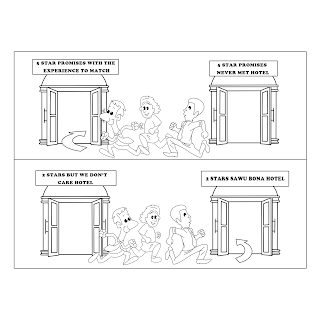
Gary Ryan provides a practical example that highlights how 5 Star and 2 Star service levels can be both good and bad. How good is the level of service that you are providing? Is it great?

Many people think that good service is only provided ‘at the top end’ of the service star scale. In other words, if I’m running a 2 star motel then only a low level of service should be provided. In the context of WHAT is provided and WHAT is paid, this is true. But the service experience can still be above expectations. 
For example, the person greeting me may be genuinely happy to check me into my room. When provided directions to my room I am asked if I am interested in knowing where some cheap but good quality food can be found. In responding yes to that question I am provided with the appropriate information, which includes a range of discounts should I choose to eat at those places. (Later, when I do choose to eat at the place, my discount is honoured and the food is reasonable for what I have paid for it).
I go to my room, the key works and my room is fresh and clean. I have asked for a non-smoking room and there is no evidence that the last person who used it smoked like a chimney. The information booklet is up to date and includes relevant information about public transport, taxis, health clubs and eateries. When I check out the staff member is courteous, quickly processes my payment and bids me farewell.  If you wish to consider a poor ‘2 Star’ experience, simply go back over this story and reverse each experience that has been described.
It would not be very difficult to translate this ‘2 Star’ story into a ‘5 Star’ story. The differences in the experience will relate to what we have paid and what we then expect to receive in return. The room may be bigger. The location may be more convenient. The bed may be bigger with higher quality linen. Internet access may be available. The fixtures and fittings may be of higher quality. An on-site restaurant and 24 hour in room service may be available. Laundry services may be available and a concierge service may be available to assist us with any needs or enquiries that we may have regarding the hotel of surrounding area. 
Each ‘Moment of Truth’ (MoM) can contribute to our expectations not being met if the experience of the MoM is not up to our expectations. In this way, 2 Star service can be great service and 5 Star service can be poor service. It all depends on the perceived experience of the customer.
Copyright Gary Ryan 2011
 
“Visits are not limited to the public areas. I head for the heart of the house, too. There’s method to my madness. If I see smiling faces and well-scrubbed surfaces behind the scenes, I know that the rest of the hotel more than likely is doing just fine.” 
J.W.Marriott Jr from his book, ‘The Spirit to Serve’
Gary Ryan enables individuals, teams and organisations to matter.
Visit Gary at http://garyryans.com

If you want to provide great service, exceed expectations!

People expect good service. Period. Often, their expectations are not met. Too often. Just think about your own experiences as a customer. How often are your expectations met? How often are they exceeded? 

Customers expect their expectations to be met. You expect your pay to arrive when it is due. You expect your food to be delivered as ordered within a reasonable timeframe and at the appropriate temperature when you order food at a restaurant or cafe. You expect finance reports to be delivered and inclusive of all appropriate information as scheduled. You expect to be treated as a human being when you visit a government agency, education institution or medical facility. 

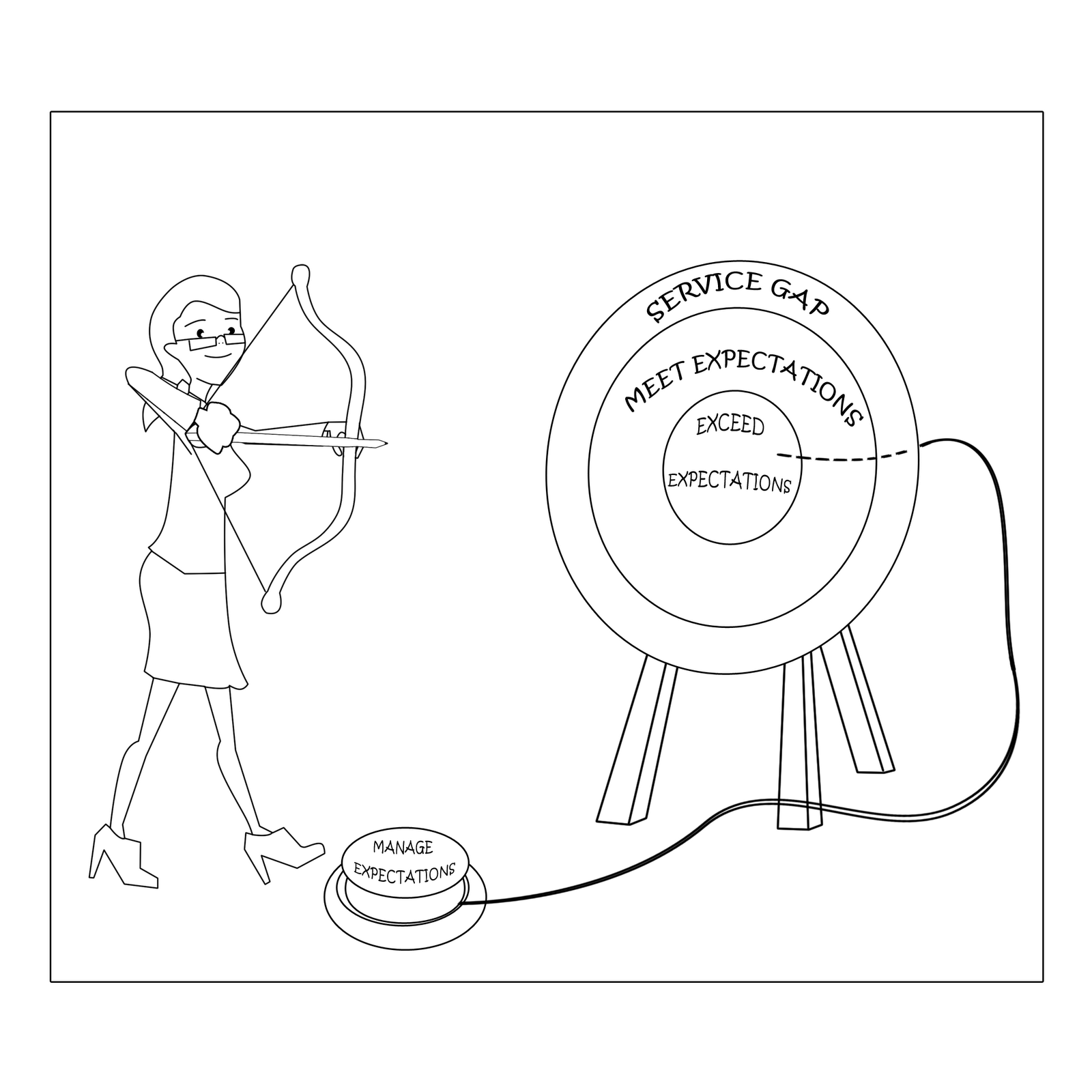
In order to be able to consistently meet expectations, your organisation must aim to exceed expectations. It is likely that there will nearly always be a lag between when you last checked the expectations of those you serve and the actual service that you are providing them. The lag time may include a change in the level of expectations of those you serve. 

Unless you are aiming to exceed the expectations at the level that you understand them to be, you may not achieve a consistent level of meeting the expectations that you do know exist. This never-ending journey means that exceeding expectations is a challenge. A real challenge. A challenge worthy of your commitment. Is your organisation currently worthy of your commitment?

Managing expectations is part of the OTM Service Strategy®

 “Consistently exceeding the expectations of the customer, personalizing his or her service experience, and continuously improving your product or service so that it creates greater value for the customer produces a level of customer loyalty that cannot be matched by your competitor.” 
Theo Gilbert-Jamison, service excellence expert/author

Gary Ryan enables individuals, teams and organisations to matter.
Visit Gary at http://garyryans.com
Rocket scientists beware, good service is good business!

It really isn’t rocket science, but in highly competitive times it makes sense that good service is good business. Even though customers are not particularly loyal, providing great service consistently and over a long period of time makes it all the more difficult for your competitors to attract your customers away from you. 
While your customers will try out the competition, if they do not receive a higher and consistent standard of service than your organisation provides, then your customers will come back and be less inclined to try out the competition again. Implicitly your customers will trust you (just as you, in turn, trust your staff). 
It is however, good practice to maintain a healthy tension about your customers trying out the competition. The day that you either think that you don’t have any competition, or the day that you stop providing good service on a consistent basis, is the day that your organisation will start to decline.
No job is secure. But good, consistent service increases the security of every job, every department and every organisation. Good service IS good business!
Good service is good business
Quote from a research participant
Great service actually feels good. It feels good for me, it feels good for the people I’m serving and it keeps the business humming along. To me, good service just makes sense.
Gary Ryan enables individuals, teams and organisations to matter.
Visit Gary at http://garyryans.com

If you listen, service excellence follows

The capacity to listen is probably the most important skill that relates to service excellence. Without this capacity staff will not know the expectations of their customers, each other, or the key stakeholders of their communities. Organisations that provide great service are fantastic listeners; to their customers, to their key stakeholders and to each other within the organisation.

William Isaacs (1999) notes that our culture is dominated by sight. Light moves at 186,000 miles per second, yet sound only travels at 1,100 feet per second. In summary, William Isaacs says that in order to listen we must slow down.

How do you and/or your organisation slow down to listen?

Quote
Our hearing puts us on the map. It balances us. Our sense of balance is intimately tied to our hearing; both come from the same source within our bodies…Hearing is auditory, of course, relating to sound. The word auditory…most ancient root means “to place perception.” When we listen, we place our perceptions. (William Isaacs, lecturer at MIT Sloan School of Management, consultant and author)

Gary Ryan enables individuals, teams and organisations to matter.
Visit Gary at http://garyryans.com

Why developing your people is at the heart of service excellence

Existing staff need to be developed so that they have the capacity to implement your Service Strategy. This will result in them having the capacity to understand the expectations of their customers and being able to develop appropriate service standards from that understanding.

New staff need to be recruited through processes that identify their alignment with your Service Strategy. This means that the organisation’s recruitment processes must reflect a process that is seeking the best possible people that it can find so that its Service Strategy can be implemented.

Quote from a research participant
Our recruitment policy used to be, “Do you know anyone who has a heartbeat and is available?”. Me, I’d been here 20 years and had never been on any training. I never realised how bad we were until I honestly thought about whether I’d like to be a customer of my own team. My answer was no!

How are staff recruited and developed in your organisation?

Gary Ryan enables individuals, teams and organisations to matter.
Visit Gary at http://garyryans.com

Service standards exist to enhance your capacity to meet and exceed customer expectations

Service standards are the in-house systems and processes, policies and procedures that your organisation has created to give it every possible chance of meeting and exceeding the expectations of its customers. They create the possibility of consistency while allowing the people in your organisation to make decisions that lead to improved service outcomes. It is not always necessary to create new service standards; many of them already exist in operating manuals, rules, procedures and policies.

The challenge is to determine whether they support or hinder great service. The ‘bureaucracy busting’ of the GE Workout program (Ashkenas, Ulrich, Jick, & Kerr, 1995) is an example of a process that at its very heart was about ensuring the company’s systems and processes remained aligned to serving people and achieving the organisation’s goals.

Quote from a research participant
We think that it is great when a new person starts work here. We encourage them to ask questions. So they do. “Why does this policy and that policy exist?” That’s what they ask. And if we haven’t got a genuine answer, then we seriously look at the policy or procedure and change it if it is no longer helping us to serve our customers.

How do your systems, policies and procedures enhance your capacity to meet and exceed the expectations of your customers?

Gary Ryan enables individuals, teams and organisations to matter.
Visit Gary at http://garyryans.com

Great service starts with identifying expectations

This is the starting point for great service. If you don’t understand the expectations of your customers, then everything that you do is likely to contribute to failing to meet them. Customers will have expectations whether you understand them or not. They usually consist of outcome factors and process factors and have a zone of tolerance for them to be acceptable.
The outcome factors relate to the reliability of the service/product and determine whether the service/product meets the customers’ expectations. The process factors relate to the customers experience and will determine if the customers’ expectations have been exceeded or not.

Quote from a research participant
Once you realise that the starting point is understanding expectations, everything else becomes a whole lot easier. All you have to do is ask people what they want, and then do your best to deliver that to them.

Gary Ryan enables individuals, teams and organisations to matter.
Visit Gary at http://garyryans.com

News Flash – Great service attracts customers!

Leonard Berry (author of On Great Service, 1995) has long advocated that great service attracts customers. This is because there are so many companies who are poor at service delivery. It is therefore easy for customers to differentiate between good and poor service companies and providing the benefit that the customer receives is more than their burden for obtaining that service or product, customers will continue to be attracted to great service.

Berry also highlights that a large benefit of great service is that positive word-of-mouth advertising is generated by great service. In short, great service attracts customers.

Quote from a research participant
For a long period of time my friend had been telling me about this bakery near where she lives. Finally I went there. She was right! The people and the ‘taste bud delights’ were fantastic! You should go there too!

Gary Ryan enables individuals, teams and organisations to matter.
Visit Gary at http://garyryans.com

Great service identifies what we shouldn’t be doing

Just as great service tells us what we should be focussing upon and where our resources should be allocated, great service also helps to identify what we need to stop doing or what we should not start doing in the first place.

Southwest Airlines is an example of an organisation that is clear about the service that its customers want. They want safe, regular, reliable services that will get them to their destination on time delivered by genuine, caring and courteous staff.

Everything else, the in-flight food, the styling of the tickets etc. is all secondary to the main expectations of its customers.

Southwest’s Customer Charter outlines how it respects and addresses the expectations of its customers. You will not find Southwest Airlines placing a lot of focus on in-flight food. While it is available, it is not the main focus of their service. So they don’t put any more effort than is required into that part of their service.

Southwest’s service focus enables it to know what to do and what not to do.

Quote
After we had expelled three members from the centre and fully refunded their memberships (even though they had already used 90% of their time) we were approached by more than 30 members who told us that if we had not acted and expelled the three people, then they would have all gone and joined another centre. It really re-enforced that our members’ code of behaviour was there for a reason. The worst thing we could have done was to have turned a blind eye to it. It would have cost us.

Gary Ryan enables individuals, teams and organisations to matter.
Visit Gary at http://garyryans.com