Category Archives: Leaders

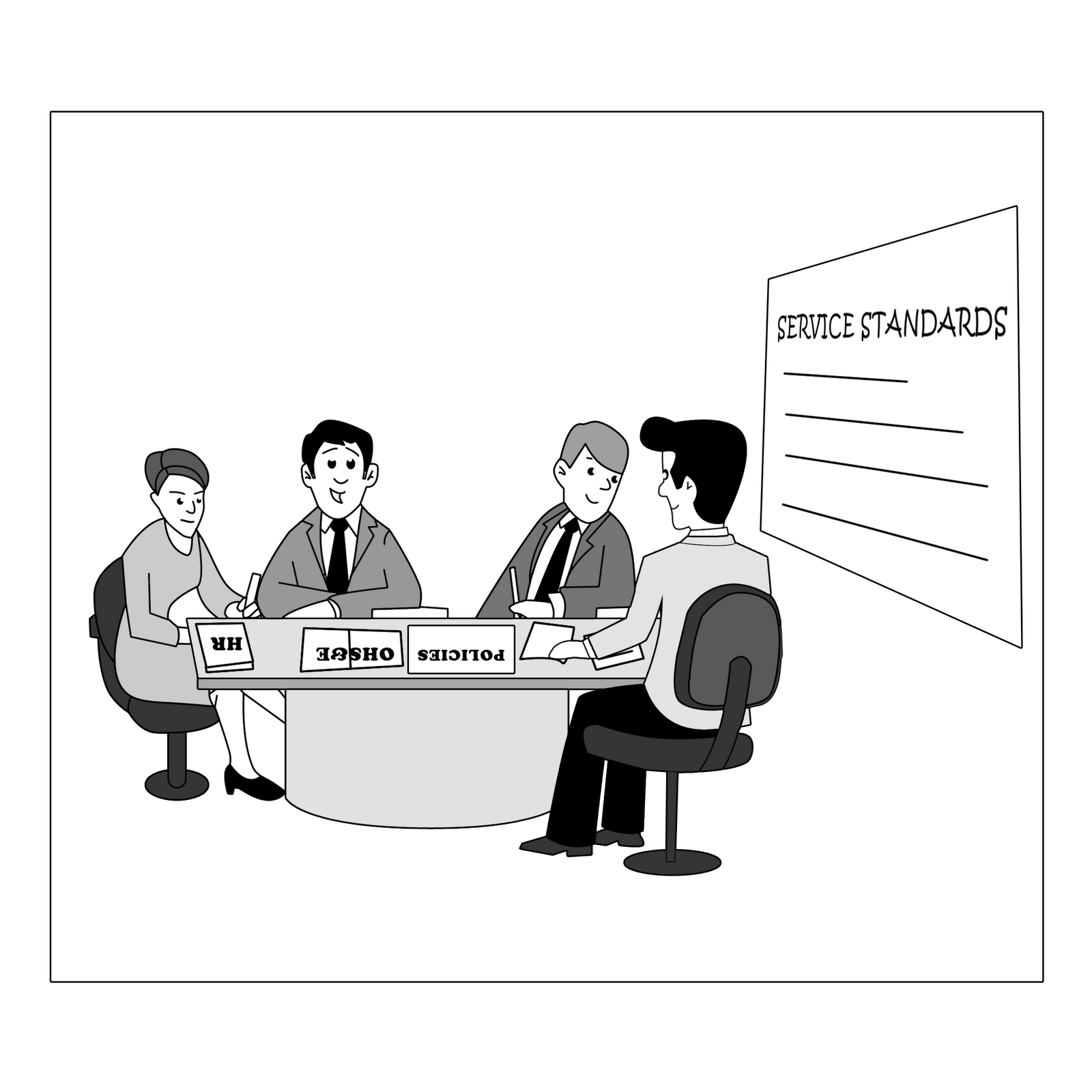
Service Standards exist so that we can create Great Service

Service standards are the in-house systems and processes, policies and procedures that your organisation has created to give it every possible chance of meeting and exceeding the expectations of its customers.

They create the possibility of consistency while allowing the people in your organisation to make decisions that lead to improved service outcomes. It is not always necessary to create new service standards; many of them already exist in operating manuals, rules, procedures and policies.

The challenge is to determine whether they support or hinder great service. The ‘bureaucracy busting’ of the GE Workout program (The Boundaryless Organisation by Ashkenas, Ulrich, Jick, & Kerr, 1995) is an example of a process that at its very heart was about ensuring the company’s systems and processes remained aligned to serving people and achieving the organisation’s goals.

Copyright Gary Ryan 2011

Research Participant
We think that it is great when a new person starts work here. We encourage them to ask questions. So they do. “Why does this policy and that policy exist?” That’s what they ask. And if we haven’t got a genuine answer, then we seriously look at the policy or procedure and change it if it is no longer helping us to serve our customers.
Gary Ryan enables individuals, teams and organisations to matter.
Visit Gary at http://garyryans.com

Expert Tip – Motivation Factor 1

In the second of the short videos in the 11 part series on how to create motivated employees, I share the first of 10 key factors that when present will collectively enhance the motivation of your team members/employees.

How would you rate for this factor?

For more information on all 10 factors and the underlying belief, visit the OTM Academy.

Gary Ryan enables individuals, teams and organisations to matter.
Visit Gary at http://garyryans.com

Expert Tip – Motivation – Belief

Over and over in the programs that I facilitate for both Senior and Developing leaders I am asked this question, “Gary, how do I motivate my team members?”

Below is the first short video in a an 11 part series that answers this question.

Join the OTM Academy here.

Gary Ryan enables individuals, teams and organisations to matter.
Visit Gary at http://garyryans.com

Who is The Customer?

Many people don’t like the term ‘customer service’ for good reason. However, this doesn’t mean that the principles of ‘service excellence’ don’t apply to how they go about doing their work. Gary Ryan explains how ‘service excellence’ enables you to exceed expectations no matter what you call your ‘customers’.

Many people get hung up on the word ‘customer’. This is the challenge with the concept of ‘customer service’ because many people think that they don’t have ‘customers’. And maybe they don’t. Maybe they have clients, colleagues, administrators, staff, stakeholders, lawyers, doctors, labourors, community members, students, guests and any other label that you can think about. The issue is not the label; the issue is the ethic behind how you treat people.
Another way of looking at it is to say that ‘the customer’ is anyone who receives the output of your work. Anyone.
This is why we prefer the term, “service excellence” over “customer service”. Unfortunately many people think that they don’t have ‘customers’ (because they use a different term) so they conclude that service has nothing to do with them. But it has everything to do with them. Everyone is your customer. Everyone.

Copyright Gary Ryan 2011

Research Participant
You know that I can’t stand the word ‘customer’. The people I serve are staff, not customers. I find out what they want and I do my best to exceed their expectations every time. So I wish people would stop saying that I have to be ‘customer’ oriented. I’m staff oriented and that is what is important!

Gary Ryan enables individuals, teams and organisations to matter.
Visit Gary at http://garyryans.com

Gap 4 – The Market – Communication Gap

If you say that you will respond to online customer feedback within 24 hours and you consistently take 48 hours to do it, then you have created a Market – Communication Gap.

The local barber who cuts my hair has two signs out the front of his barber’s shop. One sign says that the shop will be open at 8:30am. The second says 8:45am. The barber is rarely there before 9am. He has no idea how many people have looked in his window when he wasn’t open when he advertised that he would be.

My expectations are consistently not being met. One day a new barber/hairdresser will move into an empty shop in the shopping strip. What do you think I will do?

What Market – Communication Gaps are you creating?

Why not use this article to catalyse Conversations That Matter® within your team or organisation.

Copyright Gary Ryan 2011

Quote from the barber

Sorry mate. I know that I said sorry the last couple of times but my car broke down and I had to wait for my wife. Sorry mate.
Gary Ryan enables individuals, teams and organisations to matter.
Visit Gary at http://garyryans.com

How large is your Management Perception Gap?

This is a post in a five part series, each of which will explain one of the gaps.
Over two decades ago Parasuraman, Weithaml & Berry (1988) introduced the concept of Service Gaps. Each gap contributes to an organisation’s capacity to meet or exceed the expectations of its customers and the cumulative effect of the gaps have the potential for significant performance failures. The gaps are as relevant today as they have ever been.
The first gap is known as the Management Perception Gap.

Gap 1 The Management Perception Gap

A gap can exist between managements understanding of customer expectations and the actual expectations of customers. If management get this wrong, everything else they do will be wrong and the service gap is likely to grow exponentially. Organisations must do everything in their power to minimise the chances that Gap 1 exists. When was the last time your checked your perception of your customer’s expectations against reality?

Copyright Gary Ryan 2011
“Service. If you haven’t got it, don’t even bother getting out of bed if you want to be a senior leader.  It’s such an entry level requirement it isn’t even worth talking about it.”  (Jack Welch, ex GE CEO)
Gary Ryan enables individuals, teams and organisations to matter.
Visit Gary at http://garyryans.com

Are your actions undermining what you have asked your team to do?

One of my coaching clients is a coach of a semi-professional sporting team in Melbourne, Australia.

We were having a conversation about the excuses that he is receiving from players regarding their inability to make it to training. He was planning to ‘have a go at them for their lame excuses‘ at their next training session.

He provided an example that one player had told him that he couldn’t attend training because he would be attending his niece’s birthday party.

My client was frustrated. He felt that such excuses were pretty lame. “I would never have missed training for my niece’s birthday party. How lame!”

Just as I asked him if it was possible that this player did in fact place his niece’s birthday party as a higher priority than training, at least for this one day in the year, my client’s phone rang. It was one of his assistant coaches so I encouraged him to take the call.

After a few minutes he came back.

“Gee. The excuse was true. His sister is extremely unwell and her daughter is without her mum on her birthday. He’s doing the right thing.”

I couldn’t have been more excited. The information that my client received was perfect for what I was about to ask him.
“What have you asked your players to do if they can’t make training?” I asked.

“Ring or text me” he replied.

“Is that what they are doing?”

“Yes”.

“So they are doing what you have asked them to do?” I re-enforced.

“Yyyeeeesssss?” He said, his brow slightly furrowed.

The penny had not yet dropped.

“It seems to me that your players are doing exactly what you have asked. They are ringing you or texting you when they cannot attend training and providing their reasons. Yet your focus has shifted to the content of their reasons. You are focussing on whether or not you think their reasons are valid. As this example with the niece has shown, clearly you thought the excuse was lame, but when you found out the whole story you found out that it made sense.”

“What if,” I continued, “you stopped worrying about the content of the excuses you are being provided. Why not believe whatever they tell you, even if it doesn’t make sense to you. This example shows that the player involved was being honest with you. Ultimately, isn’t that what you want?”

“Yes it is” he replied.

He then said, “If I had used the niece’s birthday party as an example of the types of excuses for not training that I was getting, as I had planned to do, and I had ridiculed such an excuse I could have ruined my relationship with that player and shown the players that I didn’t really want them to be honest with me. Maybe I could use this example to show that I will believe whatever they tell me. Ultimately, if players want to lie to me, that’s about them, not me.”

He continued, “I was getting pressure from the other coaches to stop accepting all the ‘lame‘ excuses we believed we had been getting, but training attendances are actually far exceeding those of previous years. The collective data on the whole group is actually very good. I want the players to be honest with me and that is what they have been doing. I can see how easily I could have changed that behaviour and inadvertently encouraged them to tell me what they thought I wanted to hear. I’m glad we’ve had this chat!”

If you have ever played sport, or acted in a play or played in a band and felt the ‘sweetness‘ of perfect timing, this is how I felt at this point in the conversation.

I see this a lot in my work. Leaders asking their people to do something, which they then do, but the leader loses focus on what they had asked their people to do and shift their focus onto something else, albeit closely related. But they effectively ‘move the goalposts’. This causes confusion and triggers the “Guessing Game”. Team members start guessing what the leader really wants. This is extremely destructive. Yet the leader, from my experience, has little awareness that they had in fact moved the goalposts.

One of the great challenges for leaders is to maintain behavioural alignment between what they say and what they do. Fortunately, in the above example my client was able to maintain his.

What are your examples of this challenge?

Gary Ryan enables individuals, teams and organisations to matter.
Visit Gary at http://garyryans.com

A retail MBA in an article – BRW interview with Janine Allis

Rarely is an article written that captures the essence of what it takes to be a successful business person.

This recent article in BRW is an exception.

Kate Mills is able to draw from Janine Allis, founder of Boost Juice the core principles of her success, which include:

  • Maintaining focus and not being distracted from your core products/services
  • Understanding the basic factors that exist in the industry within which you operate
  • As an owner you have to really understand your business – including the parts that may not be in your areas of strength
  • You have to have and look after the right people
  • You must be tight with your spending
  • Focus on making the customer a fan
  • Look outside your box for ideas as catalysts for innovation
  • The willingness to work cannot be underestimated
  • Allis’ principles of success – her five Ps (People, Positioning, Product, Price, Promotion)

This article is well worth the five minutes it will take to read.

Let me know what you think!

Gary Ryan enables individuals, teams and organisations to matter.
Visit Gary at http://garyryans.com

Great service starts with identifying expectations

This is the starting point for great service. If you don’t understand the expectations of your customers, then everything that you do is likely to contribute to failing to meet them. Customers will have expectations whether you understand them or not. They usually consist of outcome factors and process factors and have a zone of tolerance for them to be acceptable.
The outcome factors relate to the reliability of the service/product and determine whether the service/product meets the customers’ expectations. The process factors relate to the customers experience and will determine if the customers’ expectations have been exceeded or not.

Quote from a research participant
Once you realise that the starting point is understanding expectations, everything else becomes a whole lot easier. All you have to do is ask people what they want, and then do your best to deliver that to them.

Gary Ryan enables individuals, teams and organisations to matter.
Visit Gary at http://garyryans.com

News Flash – Great service attracts customers!

Leonard Berry (author of On Great Service, 1995) has long advocated that great service attracts customers. This is because there are so many companies who are poor at service delivery. It is therefore easy for customers to differentiate between good and poor service companies and providing the benefit that the customer receives is more than their burden for obtaining that service or product, customers will continue to be attracted to great service.

Berry also highlights that a large benefit of great service is that positive word-of-mouth advertising is generated by great service. In short, great service attracts customers.

Quote from a research participant
For a long period of time my friend had been telling me about this bakery near where she lives. Finally I went there. She was right! The people and the ‘taste bud delights’ were fantastic! You should go there too!

Gary Ryan enables individuals, teams and organisations to matter.
Visit Gary at http://garyryans.com