![]() |
| Copyright Gary Ryan 2011 |
Visit Gary at http://garyryans.com
![]() |
| Copyright Gary Ryan 2011 |
![]() |
| Copyright Gary Ryan 2011 |
Gap 2
![]() |
| Copyright Gary Ryan 2011 |
This short video provides some simple, yet effective tips for understanding and communicating your core job responsibilities.
What are the three to six core responsibilities of your job?
A report by Australia’s Industry Skills Councils to the Australian Federal Government has warned that up to eight million Australians don’t have the necessary numeracy and literacy skills to train for a trade or a profession.
![]() |
| The Report provides both bad & good news |
The report also notes that over the next five years Australia will experience an estimated shortage of 215,000 skilled workers.
On the surface this may look like statistics that are extremely positive for current professionals and skilled employees. Why? Because the statistic highlight how poor the competition for skilled and professional jobs is at this point in time.
There is little to argue against this fact.
However, skilled workers and professionals need to think again. The lack of a skilled workforce and the extremely high number of people with low numeracy and literacy skills will increase the pressure on current skilled workers and professionals. Why? Because they are going to be the ones leading and managing the rest of the workforce. So the requirement for highly developed leadership and management skills are going to be paramount.
Getting and job and staying in employment for skilled workers and professionals will be virtually guaranteed (providing you are prepared to go where the work is located), however this doesn’t guarantee a great career. You will absolutely need to continue to develop your skills and employability so that you have the skills sets to lead and manage the rest of the workforce. These skill sets will continue to grow in demand and it is the people who really know how to lead and manage, and can demonstrate their skills through their track record will be the ones who will be “guaranteed” a great career.
What are you doing to enhance your leadership and management skills even if you have been leading and managing for a long time?
The Australian Government recognises Systems Thinking as a critical skill that relates to leadership. Yet very few people know what Systems Thinking is.
In the two short videos below, Russell explains the history and fundamental principles of Systems Thinking.
After viewing the videos, consider how Systems Thinking affects how you see the world and how it works, particularly with regard to how organisations work.
Part 1
Part 2
My work results in me working with Gen Zers through to Builders. Not a bad spread, is it!
Often Gen Xers, Baby Boomers and Builders bemoan Gen Y.
“They want everything now”, “They are selfish”, “They don’t understand loyalty”, “It’s all them!” are statements I regularly hear.
But Gen Y are as selfless, community focused and loyal as any other generation.
I have proof.
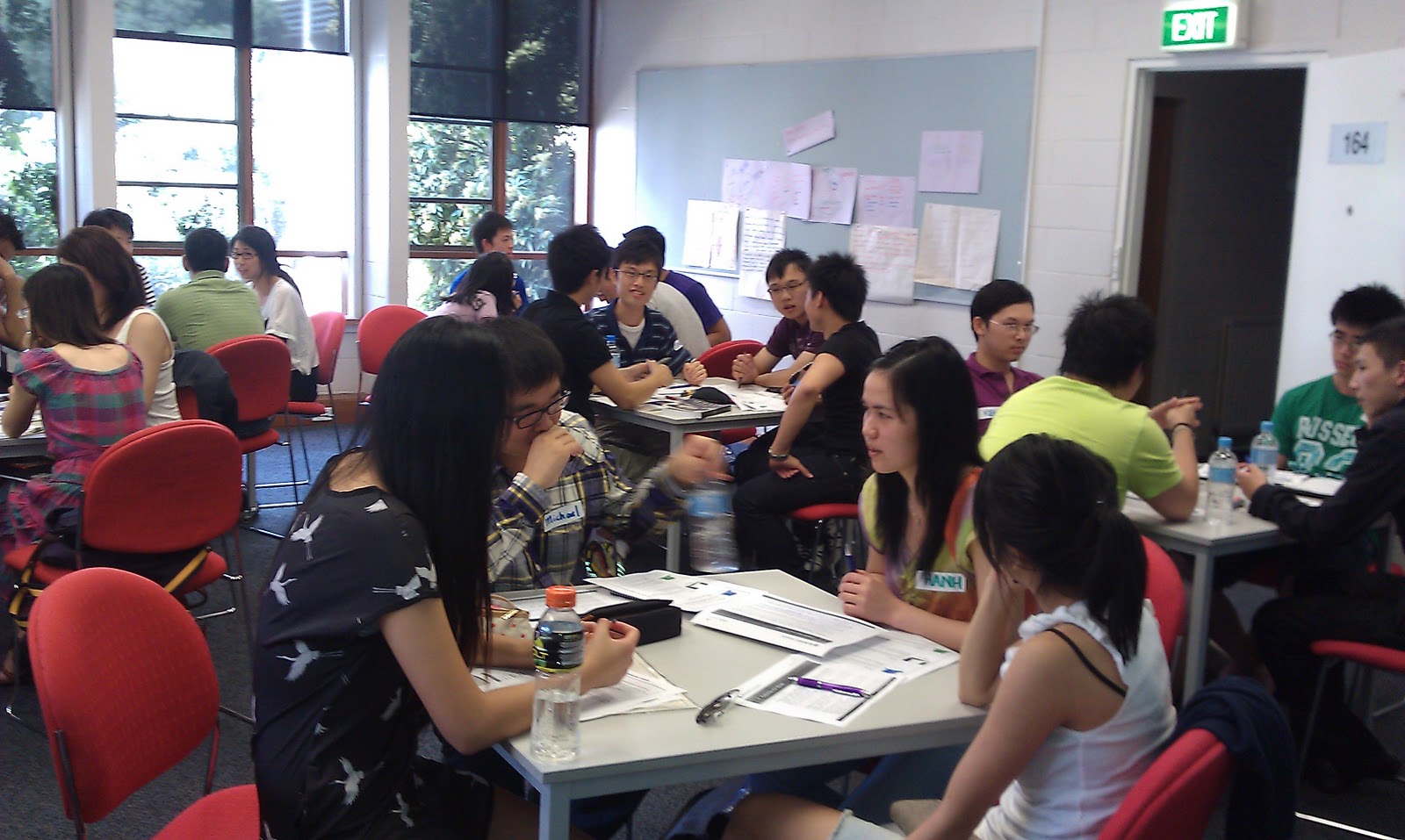
Some of the work I do with developing leaders has me working with students in various leadership programs for universities based in Melbourne, Australia. One such program, the PAL Program for the Faculty of Business and Economics at Monash University has students experiencing a range of developmental programs over a three year period. In their final year of the program the students create community based projects.
They give up their time to generate and manage sustainable projects. Last weekend 56 students gave up half of their Saturday (it was a beautiful 29 degree day too) to go through a facilitated process to create projects. Next Saturday the students will complete the first phase of this process as each ‘project team’ will participate in a workshop to ‘launch’ their project and enhance the probability of achieving their desired project outcomes.
Each project must fulfil at least one of the following principles:
The projects often end up raising awareness for charities and/or current domestic/world events. Ultimately, the students do make a positive difference through their actions (which are all in addition to their studies, part time work and anything else they might be doing with their lives). If nothing else their projects create a sense of community and belonging for students, factors that are extremely important and cannot be underestimated in terms of student well being and mental health.
A significant purpose of the program is to enhance the employability of the students by providing them with real opportunities to do real work. Universities recognise the importance of creating well rounded students who understand theory and are also able to put theory into practice. Over many years of facilitating these programs I can say that they do enhance the employability of the students. The lessons that arise from working with other talented people, within tight timeframes and limited resources (often there is no money available for the projects – the students have to generate the income they require for the projects to be funded – which create a wonderful ‘mind-shift regarding money that is invaluable) are practical, real and powerful for the students.
After each day of completing my work with these students I always walk away with high energy levels and heightened sense of positivity regarding our future. These students do care about more than themselves, they are selfless and willing to give of their precious time for a higher purpose and most importantly they do make a positive difference. Our future really is in good hands.
I look forward to sharing their successes later this year.
The capacity to listen is probably the most important skill that relates to service excellence. Without this capacity staff will not know the expectations of their customers, each other, or the key stakeholders of their communities. Organisations that provide great service are fantastic listeners; to their customers, to their key stakeholders and to each other within the organisation.
William Isaacs (1999) notes that our culture is dominated by sight. Light moves at 186,000 miles per second, yet sound only travels at 1,100 feet per second. In summary, William Isaacs says that in order to listen we must slow down.
How do you and/or your organisation slow down to listen?
Quote
Our hearing puts us on the map. It balances us. Our sense of balance is intimately tied to our hearing; both come from the same source within our bodies…Hearing is auditory, of course, relating to sound. The word auditory…most ancient root means “to place perception.” When we listen, we place our perceptions. (William Isaacs, lecturer at MIT Sloan School of Management, consultant and author)
Existing staff need to be developed so that they have the capacity to implement your Service Strategy. This will result in them having the capacity to understand the expectations of their customers and being able to develop appropriate service standards from that understanding.
New staff need to be recruited through processes that identify their alignment with your Service Strategy. This means that the organisation’s recruitment processes must reflect a process that is seeking the best possible people that it can find so that its Service Strategy can be implemented.
Quote from a research participant
Our recruitment policy used to be, “Do you know anyone who has a heartbeat and is available?”. Me, I’d been here 20 years and had never been on any training. I never realised how bad we were until I honestly thought about whether I’d like to be a customer of my own team. My answer was no!
How are staff recruited and developed in your organisation?
The challenge is to determine whether they support or hinder great service. The ‘bureaucracy busting’ of the GE Workout program (Ashkenas, Ulrich, Jick, & Kerr, 1995) is an example of a process that at its very heart was about ensuring the company’s systems and processes remained aligned to serving people and achieving the organisation’s goals.
Quote from a research participant
We think that it is great when a new person starts work here. We encourage them to ask questions. So they do. “Why does this policy and that policy exist?” That’s what they ask. And if we haven’t got a genuine answer, then we seriously look at the policy or procedure and change it if it is no longer helping us to serve our customers.
How do your systems, policies and procedures enhance your capacity to meet and exceed the expectations of your customers?