Category Archives: Leaders

How to use illustrations to create Conversations That Matter®

Creating Conversations That Matter® is a key skill for organisational leaders. Amidst forecasting, attending to meetings and writing reports, the development of this skill is often neglected. Think about it, how do you stimulate Conversations That Matter® with your peers, direct reports and your leaders? How do you stimulate them with your key stakeholders and clients?

Conversations That Matter® are conversations where people are able to speak from the heart, speak their truth (whatever it may be) in a safe environment where there will not be negative consequences for speaking their mind. This does not mean that people lose responsibility for what they say. Rather, their responsibility increases as respect is a core requirement for a conversation that matters to be conducted.

So how might a leader create a conversation that matters, especially when there may be a level of distrust present amongst team members?

One way is to use illustrations to catalyse your conversations. For these conversations to be successful, the leader must be prepared to do the following five practices:

1. Be prepared to ‘listen to understand’ to what is being said, rather than listening to defend/justify
2. Guarantee that no negative consequences will result to people as a result of the conversation
3. Listen more than speak – a good rule of thumb to follow is to speak 30% and to listen 70% of the time
4. Be prepared to ask open questions (see The Art of Skilful Questions)
5. Judge the quality of the conversation by the level of truth that is present in the conversation (see the video Transparency – How leaders create a culture of candor)

If you are able to follow the five practices above, then determine the focus of your conversation, then select an image that you could use and give it a go. As an example a great friend of ours Jock MacNeish has been creating such illustrations for the best part of his life. Over time Jock has created many illustrations for us and the 0 to 10 Relationship Management body of knowledge. As Licensed Elite Trainer Facilitators in 0 to10 Relationship Management, Andrew and I are able to use Jock’s illustrations.

The 0 to 10 Relationship Management Culture Survey illustrations are very powerful catalysts for enabling people to have a conversation that matters. If you were interested to know what your team members thought about the level of autonomy that they had in their jobs, you could place the illustration below on the table and ask them to mark on the scale where they believe the level currently sits.

When people place their finger on the scale that they believe represents their view, simply say, “Thank you for your honesty. What examples do you have that would help me to understand what this score means to you?”

Their answers will be powerful and enable you to identify what you should keep doing, start doing and stop doing. If, of course, you have tried this technique and no-one in your team spoke up, then you may have your answer anyway!

On the other hand if you’ve never tried this technique before please give it a go. Either print the illustration from this article or select a different onee for your team and create a conversation that matters. Please let us know how you go!

Finally, if you like this concept but aren’t sure what illustration to use, please provide a brief description of your issue in the comments box and I’ll help you find an appropriate illustration.

As a leader a significant part of your success is driven by your capacity to create and stimulate conversations that matter. Is this a skill that you possess? What are you currently doing to develop it?

Please feel free to ask questions and/or to make comments about this article.

Gary Ryan enables individuals, teams and organisations to matter.
Visit Gary at http://garyryans.com

A structure for creating Meetings That Matter

Ron Ashkenas, author of The Boundaryless Organization reports that most managers believe that the majority of meetings are inefficient. Despite ‘knowing’ how to conduct effective meetings they continue to practice ineffective ones.

Ashkenas offers three reasons for this behaviour:

  1. Meetings offer the opportunity for social interaction
  2. Meetings are a practical way of keeping everyone in the loop
  3. Meeting can represent a certain level of status having been attained

He provides the basic tenets of an efficient meeting to be:
“Be clear about what you want to accomplish; invite the right people; send out pre-reading in advance; have an agenda and follow it with discipline; send out notes with key decisions and action steps.”

From my experience one of the problems with the prescribed successful meeting process is that people are too busy to do the required pre-reading. In fact, most managers have reported to me that they don’t have the time to pre-read the prescribed agenda. This is something they do on the way to the meeting or when they first get there.

Managers have also reported to me that they don’t focus on the content of the meeting “…until I am there.”, especially when they are travelling from one meeting to the next.

In this context it seems near impossible to create efficient meetings. Thankfully there is a way, but it will take some of you some time to get used to the ‘instant formality’ that the process creates.Organisations That Matter, Gary Ryan, Yes For Success, Leadership, Plan for personal success

Step 1: Provide an opportunity for staff to ‘check in’ at the start of the meeting (keep it short)
Efficient meetings require all present to be ‘present’ during the meeting. Wandering minds don’t aid efficiency. The purpose of the ‘check in’ is to allow team members to psychologically separate from what was going on before the meeting to focusing on the meeting that is happening ‘now’.

A ‘check in’ can be a single word where everyone is asked to share how they are at that moment through to just those feeling the need to share a recent experience that may be on their mind (e.g. I nearly had a car accident on the way here).

Step 2: Clarify the purpose of the meeting
Even if this is a regular meeting, remind people why it still matters. If the meeting no longer matters then you shouldn’t be wasting your time conducting it!

Step 3: Collectively set the agenda
Publicly create the agenda. A whiteboard is perfect for this task (remember there is power in the whiteboard marker, so while you are teaching people this method it is best to be the ‘scribe’).

Accept all suggestions from all team members. Then select the most important items that need to be addressed today. It is okay to use your positional authority as necessary when completing this task.

Literally place numbers beside each item as you prioritise them.

Next allocate approximate time slots for each agenda item that you have agreed to talk about. These time slots do not need to be equal – they need to be relevant to the importance of the agenda item and how long (in the available time) you have to discuss the item.

Step 4: Set a time-keeper
A team member will need to take on the role of time-keeper. It is amazing how often the simple statement that we have used our available time on an item results in the discussion ending. Please note that this role can (and probably should) move around the team members from one meeting to the next.

Step 5: Make a record of the meeting
Create meeting notes that highlight the agreed agenda and any actions that result from each item. This can be done by using the left hand side of the whiteboard and recording the actions as they arise throughout your meeting. Share the meeting notes in a timely fashion. This can be done by using your smartphone to take a photo of the Action Items and then immediately distribute the photo to all team members. You can leave the meeting without any extra administration tasks to be completed!

Step 6: Reflect on the meeting skills displayed throughout the meeting
This step spends a few minutes providing the opportunity to team members to talk about their thoughts about how well meeting skills were displayed by the team members. Comments such as, “Joan asked a lot of powerful questions today. Especially when she asked me about the most powerful benefits for the organisation that my suggestion would provide. It really made me stop and think more clearly about why this project matters.” provide an example of what might be said during the reflection.

That’s it. Like anything new this six step approach will feel strange at first, but you will get used to it.

Please feel free to ask questions about any of the six steps outlined above.

Please note that this article was catalysed by a recent conversation with one of my Executive Coaching clients. Thanks Elise!

Gary Ryan enables talented professionals, their teams and organisations to Move Beyond Being Good.
View a TedX Talk by Gary here.

Government grants enhance the affordability of culture change programs

A combination of state and federal government schemes designed to enhance the formal qualifications of Australians have the added bonus of providing the resources for corporate culture change programs.

The challenge is that many leaders aren’t aware of the opportunity they have available to them and therefore don’t fully leverage the culture change opportunity.

As a facilitator of such programs I help senior leaders recognise that the real benefit of the programs is the conversations about their business that the course material catalyses. In simple terms, the course material and the courses themselves create the space for staff to talk about their organisation in a safe way. In other words, they have the opportunity to have Conversations That Matter®.

In every session that I have facilitated staff have learned something about their business that they did not previously know. Often this knowledge was considered by others in the room to be “known by everyone”. Yet it quickly becomes obvious that not everyone did know.

For example one organisation with whom I have been working has a bonus system in place that rewards staff for submitting ideas via their intranet that, if adopted and they produce measurable business improvements a bonus is paid to the employee. A lot of the mid-level managers in the program didn’t know that the system existed.

If it wasn’t for the program and the opportunity to talk about organisational systems designed to enhance idea generation, the conversation that resulted in the knowledge sharing would not have occurred. This type of conversation occurs in every session.

The opportunity to overlay the program with a specific culture change focus is both available and logical. Why not use government funding to pay for a program that enables real conversations about the organisation to be conducted that are influenced by theory! In addition, the program provides employees with a nationally recognised qualification.

In fact, it is my experience that corporate programs offer the greatest opportunity for theory to be understood and applied because the program creates the space for colleagues to apply theory to the practical operation of their business. In many cases the theory can then be applied in real time.  When properly understood and facilitated such opportunities can provide enormous benefits for everyone.

Please feel free to contact me if you are interested in how such a program can benefit your organisation and employees.

Gary Ryan enables individuals, teams and organisations to matter.
Visit Gary at http://garyryans.com

Does clutter detract from the services you offer?

Clutter creates stress and creates a sense of disorganisation. What systems do you have in place to keep both front-of-house and back-of-house areas free from clutter?

If you ‘sweep your mess under a carpet’ rather than clean it properly, your back-of-house systems and processes will eventually let your front-of-house operations down.

Would you be comfortable letting the public see your back of house operation? If not, why not?

What could you do about this situation?

Copyright Gary Ryan 2011

 Research Participant
Our back of house operations had always been a shambles. But we seemed to keep getting away with it. Until one day we didn’t. And the company nearly went broke because of it. Luckily we survived and we cleaned our act up. Literally!


Why not use this article as a catalyst for Conversations That Matter® within your organisation.

Gary Ryan enables individuals, teams and organisations to matter.
Visit Gary at http://garyryans.com

Kindle version of ‘What Really Matters For Young Professionals!’ released today

Today I have some exciting news to share with you.

A Second Edition of What Really Matters For Young Professionals! How to master 15 practices to accelerate your career has just been released on Amazon Kindle.

In the book you will discover:

  • How to capture your stories that reflect your employability
  • How to identify your personal values
  • Why behaving in an aligned manner with your organisation’s values matters
  • How to communicate effectively with email
  • Why Dee Hock, the founder of VISA International recommends developing Servant Leadership skills
  • Why having mentors in your life is crucial for personal and career success and how to find them
  • How to stop yourself from jumping to conclusions so that you communicate effectively in the workplace
  • What Systems Thinking is and how to use it throughout your career
  • And much, much more!

Even more exciting is the price – just US$4.97.
The timing is perfect for anyone who has just finished their university year or degree.

However, the book isn’t just for people who are at the start of their career – seasoned professionals have found the content of the book extremely useful for helping them to do the little things that help them to continue their success.

The book isn’t just for Kindle Readers either – if you have an iPad or other tablet you will easily access apps that will allow you to read your Kindle books on those devices.

You can access your own Kindle version of What Really Matters For Young Professionals! here.

More information regarding the book, including a short video can be accessed here.

I am confident that you will find this version of the book even more value than the first. Enjoy!

Til next time, please keep learning and be the best leader that you can be!

Gary Ryan Founder – Organisations That Matter

Gary Ryan enables individuals, teams and organisations to matter.
Visit Gary at http://garyryans.com

Personal Values Enhance Organisational Commitment

Many of us already knew this to be true. The more clear a person is about their personal values, the more able they are to commit to an organisation. The more committed you are to an organisation the better you perform for that organisation.

James Kouzes and Barry Posner, famous for their Leadership Challenge series of books have provided the evidence that awareness of personal values matter as they relate to organisational commitment and performance.

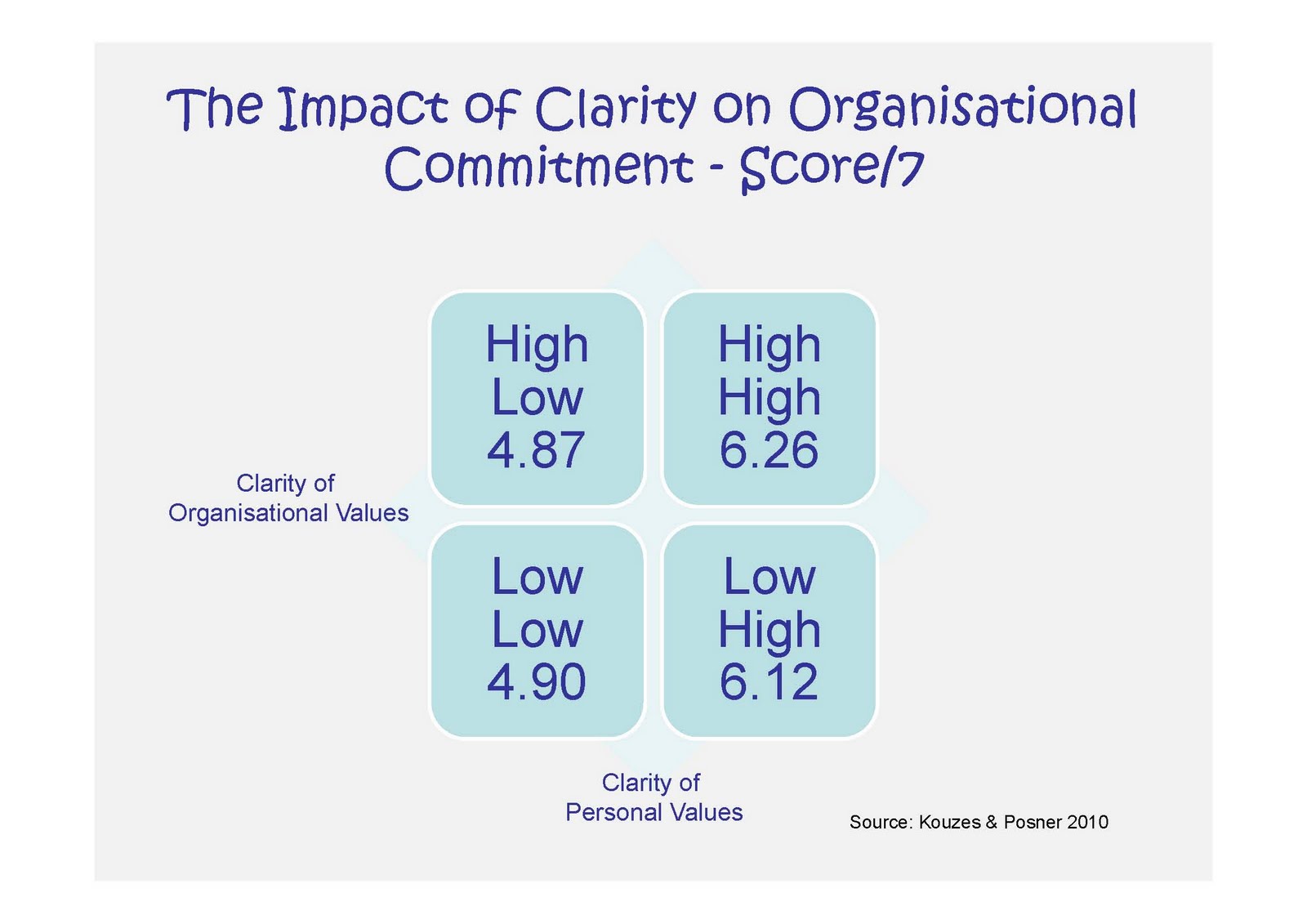
In The Truth About Leadership (2010) they show the result of their work with thousands of participants.

As the illustration highlights (where the highest possible score in any one box = 7), their is no significant difference between the commitment of employees who have both clarity of personal and organisational values compared to those who only have clarity of personal values.

There is however a significant difference in terms of both of those two groups compared to employees who have low clarity of both personal and organsiational values and those employees who have high clarity of organisational values but low clarity of personal values (once again there was no significant difference between these two scores).

So what does this mean in English? It means that it is worth assisting your employees to gain clarity about their personal values. How many organisations do that? Not many from my experience. And while there appears to be no significant difference between just having clarity of personal values and having clarity of both personal and organisational values, it makes sense to me to have both if you can. But the starting point is personal values. Help you employees to know them.

The reality is that it isn’t very hard to help people to clarify their personal values. You just have to know what to do and how to do it.

Within my online community (The OTM Academy) I have a six minute video that helps people to clarify their values, or you can simply follow the instructions laid out in my book What Really Matters For Young Professionals!

Are you clear about your values?

Gary Ryan enables individuals, teams and organisations to matter.
Visit Gary at http://garyryans.com

What Really Matters! Volume 3, Number 3, 2011 ebook out now!

This ebook is a compilation of key articles from the OTM Academy. The articles focus on developing senior and developing leaders who share our view that organisational success is created through enabling people to shine! Contributing authors include Gary Ryan, Ian Berry, Judith Haskins and Troy Simmonds. The ebook design was created by Janine Ripper. Please join the OTM Academy to access more resources.

Gary Ryan enables individuals, teams and organisations to matter.
Visit Gary at http://garyryans.com

Student Ambassadors Develop Their Employability Skills

Congratulations to the Monash University Pharmacy and Pharmaceutical Sciences students who participated in the 2011 Ambassador program. It was a pleasure to work with you all and it is a delight to be able to publish this ebook that highlights your community projects.

Folks these projects have produced a genuine win-win for everyone involved. The students win by having a practical opportunity to develop and enhance their leadership and employability skills, the university wins by having such wonderful Ambassadors engaging with the community and the community wins by having the students provide access to information about university life.

Please view in Fullscreen mode.

Gary Ryan enables individuals, teams and organisations to matter.
Visit Gary at http://garyryans.com

Service excellence requires measuring and responding

A fundamental aspect of service excellence is the tools that an organisation uses to measure how it is performing.

In this context the Service Standards that form the basic building blocks of the organisations systems and processes have to be able to be measured. At their highest level organisations should be able to recognise how they are performing at each of the six key drivers of service excellence and each local team should be able to do likewise.

The capacity to appropriately respond to what the measurements are telling an organisation is also critical for service excellence. This means that your measurement systems must be time bound so that the information is current and therefore useful. Some measurements will be lag indicators of activities that have been completed in the past, while other measurements will provide lead indicators identifying where a particular aspect of your service strategy is headed into the future.

A lag indicator may be your sales results for the past month. A lead indicator may be the number of customer ‘contacts’ you have ‘alive’ in your marketing funnel which will act as an indicator for how many sales you may make the following month.

How do you measure your service standards? What lead and lag indicators are you using?

Copyright Gary Ryan 2011

Research Participant
It wasn’t until we started to look at our service strategy and ask ourselves whether or not we were measuring what was really important to us that we started to improve. We had promised people that we would get back to them within 24 hours but we didn’t have a clue whether or not we were achieving that standard. To our horror we discovered that our response time was more like 36 hours than 24 hours. It took us about three months but we eventually got our average down to 10 hours, well ahead of the base standard that we had set.

Please feel free to use this article to stimulate Conversations That Matter® within your organisation.

Gary Ryan enables individuals, teams and organisations to matter.
Visit Gary at http://garyryans.com

Recognise, Reward and Celebrate Great Service

All organisations need to be able to recognise how they are performing with regard to their Service Strategy.

They also need to have the capacity to recognise and reward their staff for their great service.

Celebrating milestones and achievements is a critical aspect of a service culture and sends positive messages to staff about the value that great service holds within the company.

Establishing programs that recognise and reward staff for great service are essential tools for re-enforcing what really matters in your organisation.

I have been fortunate enough to both lead and be part of teams who have been nationally recognised for their achievements in providing great service. To watch those team members shout with joy when their organisation’s name was called out has been a delight. Think about it – these people were shouting for joy as if they were at a football match and their team had just scored a goal. Well their work team had just scored a goal – a goal in providing great service!

The energy that the recognition created was tangible – you literally could ‘feel it’ and the benefit for staff engagement and continuing on the continuous improvement journey was well worth the effort to enter the awards competitions.

How do you recognise, reward and celebrate great service?

Whether you are big or small, you cannot give good customer service if your employees don’t feel good about coming to work. (Martin Oliver)

Please feel free to use this article as a catalyst for Conversations That Matter® inside your organisation.

Gary Ryan enables individuals, teams and organisations to matter.
Visit Gary at http://garyryans.com