Category Archives: Leaders

Awareness matters!

The scene
I had been asked to attend a late afternoon meeting with a client in a different part of the city to which my office is located. I decided to drive to the meeting so that I could drive home. As luck would have it, a one hour metered carpark was available immediately outside the client’s building.

Upon arrival the receptionist asked where I had parked. I informed her that I had parked in the one hour zone out the front of the building.

I was shown to the meeting room and some cool, fresh water was provided. I was informed that the person I was meeting had been held up in another meeting off-site and was on his way, possibly being 30 minutes late.

The moment that mattered

Prior to the arrival of my client, the receptionist popped her head back into the meeting room and asked whether it would be okay for her to pop downstairs to ‘feed the meter’ for me.

I had started to wonder how I was going to manage the parking situation given that a large period of my 60 minutes had been ‘chewed up’ waiting for my client to arrive. The awareness of the receptionist, Crystal, to help me was just terrific. Crystal realised that I might be starting to worry about my car and that the parking issue could end up being a problem for me should the meeting last longer than the now available 30 minutes.

To me Crystal’s actions highlight the importance of awareness and how it is directly linked to service excellence. Crystal could not control whether my client’s availability, but she was able to control her awareness to relieve a problem before it occurred.

That is exactly what awareness does. It ‘heads problems off at the pass’, before they have a chance to take effect.

What are your examples of how awareness has both enhanced service excellence and resolved a problem before it occurred?

Gary Ryan enables individuals, teams and organisations to matter.
Visit Gary at http://garyryans.com

Why workplace trust is a challenge

The challenge with workplace trust, whether from leaders to employees or employees to leaders or employees to employees is that to trust another person you must be willing to be vulnerable. That is, the act of trusting someone means that you are openning yourself up to the ‘risk’ that whoever you are trusting could ‘break’ your trust.

You see, trust cannot be broken unless it is given in the first place.

This is one of the factors that makes trust within an organisation so hard.

Whether this be from leader to employees, or from employees to leaders. The same is true.

In this context leaders must be able to demonstrate that they are willing to be vulnerable by trusting employees, and employees need to demonstrate that they too are willing to be vulnerable by trusting their leaders.

I’m suggesting that trust is built by demonstrating trust and being open to the vulnerabilities that come with trusting others.

What are your experiences of organisational trust?

Gary Ryan enables individuals, teams and organisations to matter.
Visit Gary at http://garyryans.com

How great service attracts requests for a broader range of products/services

In much the same way that great service attracts new customers, it also attracts existing customers to enquire about new services/products that may be provided by the organisation. Consulting firms in particular are familiar with this phenomenon. Satisfied clients will request if new services can be provided before seeking another consulting firm to supply the service. This can help an organisation grow.

A word of warning.

Just because a customer asks your organisation to provide a new service or product doesn’t mean you should do it. As long as the new service or product fits with your organisational purpose and will continue to take the organisation towards its desired future and the organisation has the capacity to provide the new service, then it should do it. Otherwise it should refer the customer elsewhere. This too is great service.

How is delivering great service increase resulting in requests for ‘more’ from your clients/customers?

Client quote
Because of the great job that you did with our leadership training I was wondering if you could assist with improving our inter-departmental relationships? I thought that I’d check with you first before trying out some of our other suppliers.

Gary Ryan enables individuals, teams and organisations to matter.
Visit Gary at http://garyryans.com

Service enables us to identify our customers

Your customers can be colleagues, your supervisor, the staff who report to you, the people and/or organisations to whom you provide services, the people who pay for your services or products even though others may use them. Often your service or product will have multiple layers of customers. The customers who actually use your service or product may be different from the customers who purchase your service or product. A service focus helps both you and your organisation to identify and differentiate the expectations of these different customer segments. If you don’t get this right, you may be left with no customers at all.

Understand your customers across the multiple levels of service you provide. Do you understand yours?

Quote from a research participant
“I first thought that this service training stuff was a load of, well, you know! But it got me thinking. Who are my customers? Funnily the first person who’s head popped in my mind was my boss’s. I’d never really thought of my boss as a customer. Yet, she probably is.”

Gary Ryan enables individuals, teams and organisations to matter.
Visit Gary at http://garyryans.com

Why Creative Tension Trumps Problem Solving

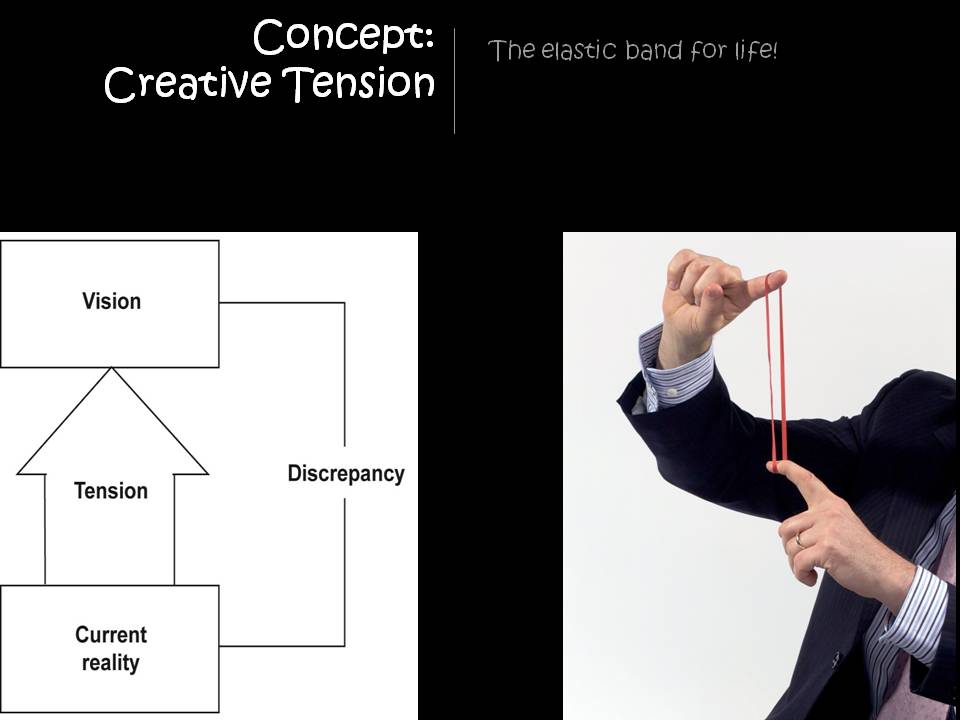
Creative Tension involves three simple concepts that, when put together, create a structure that provides the energy for effective action. Many of you will have seen me refer to the ‘elastic band’ metaphor (see TEDx Talks – Creating a Plan For Personal Success) that enables us to create the life we desire.

You see, Creative Tension is about creating what we want. Problem Solving, on the other hand, largely focuses on what we don’t want.

Artists tend to use Creative Tension while people in business tend to use Problem Solving. My argument is that business people should follow the practices of artists and also focus more on using Creative Tension rather than Problem Solving.

Artists
Imagine that Pink has decided to write a new album. What approach do you think would provide Pink with the biggest probability of creating an album full of smash hits.

a) To take the approach that at the start of the writing process that she has a problem to resolve. The problem is, “I don’t have any new songs ready to put on my album.”

To resolve this problem Pink may recruit a bunch of her musician friends and brain-storm a heap of ideas that they believe would be likely to eventually generate the ‘right’ songs for her album. As each song is recorded Pink’s problem would reduce because she would now have some songs for her album. Finally Pink would finish her album and release it to the public.

b) To take that approach that an album is a work of art and that the art requires some form of inspiration. Focusing on the quality of the album that she wishes to create, Pink would generate a number of experiences to enable her to fully picture what the album will be like.

Once the ‘direction’ of her album is clear, Pink would then recruit artists to help her to bring her ‘picture of success’ into reality. The number of songs on the album and the length of the songs would all fit into Pink’s vision of what the album was going to look like. Eventually, Pink would ‘create’ the album that she desires.

Music, art and films are all treated as creations to be made rather than problems to be solved. Alfred Hitchcock is famously reported to have refused to let his writers ‘close out’ a story line too early. Instead, Hitchcock would prefer to ‘hold the tension’ of an unfinished storyline so that true creativity amongst he and his writers could be inspired. The result; Hitchcock became one of the greatest film directors of all time and is still known today for creating stunning plots, scenes and movies.

Business people
Business people want to be successful, just like artists do. However business people are trained to see problems and to focus on fixing those problems. Common problems that business people try to fix include:

* The problem of under-performance
* The problem of low motivation in employees
* The problem of maintaining efficiencies
* The problem of low supply and high demand
* The problem of high supply and low demand
* The problem of not enough resources
* The problem of poor communication
* The problem of poor internal service
* The problem of poor external service

Really, this list could go on and on, but I think you ‘get’ the picture.

Business people use the same approach to these problems as described in ‘a’ above for the artists. They gather a group of colleagues, brainstorm a bunch of ideas to resolve the problem, select the ‘best’ answer and then implement that answer in the hope that the problem is resolved.

Usually the ‘best answer’ does have an impact on the problem and it does reduce in its intensity. As this occurs and the original problem is less of a problem, less effort is put into resolving the problem. Why? Because now other, more serious problems require focus. And so the process goes, on and on and on. A bit like a dog chasing its tail!

What if, on the other hand, business people learnt to focus on what they are really trying to create? Rather than focusing on problems that need to be resolved, what if business people focused on the customer experience, the employee experience, the community experience of their service or product? And what if this focus was present at all levels of the organisation?

There is a difference between art and business
Art is generally not released to the public until it is created. In many ways art is created in a vacuum. Once created it is then released. Business is different. Much of what goes on in a business can’t be placed into a vacuum until it is created. The way the world works simply won’t allow it. In business we ‘change the wheels on the bus while the bus is driving down the road’.

It is for this reason that problem solving, in a business context is still relevant. There are some problems that simply have to be resolved. Such as an unhappy customer ‘right now’. However, what if problem solving in a business was provided within the context of Creative Tension? In other words, what if the experience that we are trying to create for our customers, or the experience and culture that we are trying to create for our employees was the guiding force for our strategy, actions and problem solving?

Creativity is challenging because of the tension that is generated when we become clear of what we want, but have no idea of how to bring what we want into reality. Artists experience this tension all the time and have learned to embrace it. Business people on the other hand are scared out of their minds when they don’t know ‘how’ to bring the future they desire into reality. This is why most business people focus on Problem Solving rather than Creative Tension. Problem Solving is simply more comfortable. “We know ‘how’ to problem solve. We don’t know ‘how’ to create.”

If you are not sure of what I mean you might like to view the video The Gates (below). As you watch the short video, consider the power of Creative Tension that went in to bringing the vision of art on such a large scale into reality.

How present is Creative Tension in your organisation? What are your examples?

Please feel free to comment on this article.

Gary Ryan is a founding Director of Organisations That Matter and can be most easily contacted at Gary.Ryan@orgsthatmatter.com .

I would like to recognise Robert Fritz whose writing over the past two decades has inspired my thinking and practice on this topic.

Gary Ryan enables individuals, teams and organisations to matter.
Visit Gary at http://garyryans.com

Is your message and the experience you create aligned?

This really isn’t rocket science but I am continually amazed at how many organisations get this wrong. Recently my family have been doing high school tours to help us make a decision regarding the right school for our eldest child.

The schools have had many different approaches to this process. However, their messages have been very similar, “We create a caring, belonging and nurturing environment for your child where we seek to create well rounded young adults with strong academic and life skills.”

Yet it is our experience of this message that has stood out the most for us. One school that had over 900 students crammed us into a room where three teachers and three students spent 60 minutes ‘telling’ us about the nurturing and sense of belonging that the school creates. The speeches were fine, the images shown to us on the Powerpoint presentation also looked fine.

The teachers then stayed in that room while the three students led over crowded tours around the school. Classrooms were closed, it had become dark and lights were off and we spent most of the time peering in through windows trying to get a sense of what the school was like.

After a while the litter on the ground became more and more noticeable. After all, there wasn’t much else to see or experience.

It seems to me that if you are going to promote a sense of belonging, then that is the ‘experience’ that you should do your very best to create. This is a classic case of ensuring that your message and the experience you create are aligned. All it takes is a few moments to ask this question, “Is the experience we are going to create aligned with our message?”

The school I have described is no longer on our list. Other parents who have also visited the school for their tours have expressed similar concerns. The school is completely unaware of the misalignment between their message and the experience they are creating.

How do you make sure that your message and the experience you create are aligned?

Gary Ryan enables individuals, teams and organisations to matter.
Visit Gary at http://garyryans.com

Service helps us make sense or our strategy at the day to day level

Business strategy focuses upon enabling an organisation to move from its present state to a desired future state. It provides the ‘roadmap’ for this movement. Ultimately this results in thousands upon thousands of actions happening throughout the organisation. The intention of these actions is to move the organisation in the desired direction that the strategy dictates.

Each action is therefore an example of the organisation’s ‘strategy in action’. A clear service focus enables these actions to ‘make sense’ in the context of the overall business strategy and can help to connect the people within the organisation to the business strategy on a day to day, action by action level.

Quote from a research participant
When I understood that all I had to do was to focus on understanding the expectations of the people I serve, the whole service thing became a lot clearer. I’m not into big words and I’m not a manager, but I can find out what people expect of me and do my best to fulfil those expectations.

Gary Ryan enables individuals, teams and organisations to matter.
Visit Gary at http://garyryans.com

Learn how to ask ‘Questions That Matter’

Questioning skills are highly under-rated. Enhancing your ability to ask Questions That Matter will have a profound impact upon your ability to effectively communicate with, and to lead people.

No matter what your organisational role, developing this skill will enhance your effectiveness and performance.

In this interactive webinar recording Gary Ryan provides insights to the basic qualities of creating Questions That Matter.
Duration: 45 minutes.

Gary Ryan enables individuals, teams and organisations to matter.
Visit Gary at http://garyryans.com

It’s good business to increase complaints!

The American Express Global Customer Barometer has highlighted the importance of being easy to complain to, especially in places like Australia.

The Australian figures, second to Mexico, highlighted that 86% of Australians will cease doing business with an organisation after a bad service experience. Yet the majority of these Australians will not tell the organisation about their experience. Rather, they will tell their social network, especially if asked. The research reveals that the reason for this behaviour is that Australians find organisations notoriously hard to complain to. So instead they simply switch and tell their friends.

What is interesting is that approximately one in two of these same Australians are willing to give an organisation a second chance, especially if they have previously had good service experiences with that organisation. The issue is that after the second chance, the Australians will simply ‘disappear’ as customers, especially if there is a viable alternative that is available to them.

The pure economics of the above statistics highlight that it is good business to increase complaints. If an organisation were to become ‘easy’ to complain to, that same organisation would have more of a chance to ‘recover’ the customer and maintain a positive relationship with them and stop them from leaving. In simple terms this means that the company ensures that future expenditure from this customer will remain with them.

We are fortunate to live in a world where a customer complaint can be made to a social network and, if you are easy to complain to, that complaints will be heard even though it wasn’t said directly to your organisation. At the end of the day it doesn’t really matter where the complaint is made, it matters that it is heard and acted upon.

As an example I recently had a poor service experience about an organisation. I ‘tweeted’ that I was going to write a blog about my experience, which I did the following day. Within eight hours of posting my blog I was contacted by a representative of the company asking for more details and wanting to know how they could resolve my issue for me. Within a couple of days a resolution for my poor experience had been created and I have remained a client of that organisation.

I had no idea that the company had set up (due to a recommendation from a teenage casual contact centre staff member) a ‘twitter watch’ and a ‘blog watch’ to look for complaints (and positive comments) so that they could fix them as quickly as possible.

It is in this manner that an increase in customer complaints should be seen as a positive measure rather than a negative one. Unfortunately it is my experience that most companies see increased complaints as a poor result rather than a positive one. Alas, most companies are poor to complain to because they don’t want their complaints metrics to rise. Silly, isn’t it!

How easy is your organisation to complain to and what are some examples of how this is done?

Gary Ryan has led service excellence award winning teams in multiple categories and is a co-creator of the OTM Service Strategy.

Gary Ryan enables individuals, teams and organisations to matter.
Visit Gary at http://garyryans.com

Improve your listening by enhancing the quality of your conversations

So you are in yet another meeting. The conversation is flying back and forth yet you feel frustrated by the lack of people really listening to each other. In fact, you find yourself waiting for a ‘gap’ in the conversation so you can throw your two cents worth into the debate.

The meeting ends. Everyone respectfully nods at each and walks out feeling that the meeting was largely a waste of time, again! You wonder why so many of the meetings that you attend seem to go around and around without people really listening to each other. You try to listen yourself but you find that your listening is just as bad as everyone else’s. The real cost as a result of the time wasted in these meetings seems to high to even calculate. Yet the problem persists.

Yes you have been to communication workshop after communication workshop. But it seems that learning to become a better listener is like shouting at grass to grow. Just because someone says that you should listen and paraphrase and watch your body language doesn’t actually mean that you’ll become a better listener, just like grass won’t grow any faster just because someone is shouting at it!

What if there was a technique that enabled you to become a better listener, yet didn’t require you to specifically focus on listening?

If you shift your focus away from becoming a better listener to becoming a contributor to higher quality conversations, it is amazing how your listening improves! Higher quality conversations or Conversations That Matter® enable us to see things differently; new horizons, new possibilities, new ways of working together which result in tangible benefits such as new innovative products, new savings, better efficiencies. As Juanita Brown and David Isaacs shared in their wonderful book, The World Cafe, “…accepting the centrality of human conversation as a key organisational means for achieving desired results entails a profound shift of mind – from seeing conversation as a peripheral activity to seeing conversation as one of the organizations most valuable assets.”

So how do you even start to create this profound shift of mind?

One way is to start to focus on the quality of the questions that you ask in a conversation. Think about it. What positive difference to the quality of conversations that you participate in would an improved quality of questions (even from just one person), make to that group’s conversation? Brown and Isaacs suggest that focusing on the right questions themselves is a powerful way to enable people to open their minds to higher quality conversations. For example, what if in one of the meetings described above you asked, “What questions, if answered, would enable us to achieve the results that we truly desire?”
 
Part of the reason for the consistently low quality of conversation that many of us experience in organisations is due to the fact that most people are focusing on answers rather than discovering the right questions that are worthy of an answer. For example, how easy would you find it to come up with questions in response to the question above, without trying to answer your own questions first? It is my experience that many people are uncomfortable focusing on generating questions (without answers) largely because it is a skill that has had little attention or focus throughout their development.

At your next meeting, as you follow the conversation, try focusing on this question, “What’s the most powerful question that I could ask that will help to improve the quality of this team’s conversation?”.

A side benefit of focusing on asking powerful questions is that your listening will improve, without you having to focus on it. Try it, you will see that this is true.

I’m interested in hearing about your experiences with regard to enhancing the quality of your workplace conversations through improving your questioning skills.

If you are interested in discovering how to ask ‘Questions That Matter®’ you may wish to join my free webinar on that topic on Thursday 22nd October, 2010. Please register here if you are interested.

Gary Ryan enables individuals, teams and organisations to matter.
Visit Gary at http://garyryans.com