Category Archives: Leadership Development

Personal Values Enhance Organisational Commitment

Many of us already knew this to be true. The more clear a person is about their personal values, the more able they are to commit to an organisation. The more committed you are to an organisation the better you perform for that organisation.

James Kouzes and Barry Posner, famous for their Leadership Challenge series of books have provided the evidence that awareness of personal values matter as they relate to organisational commitment and performance.

In The Truth About Leadership (2010) they show the result of their work with thousands of participants.

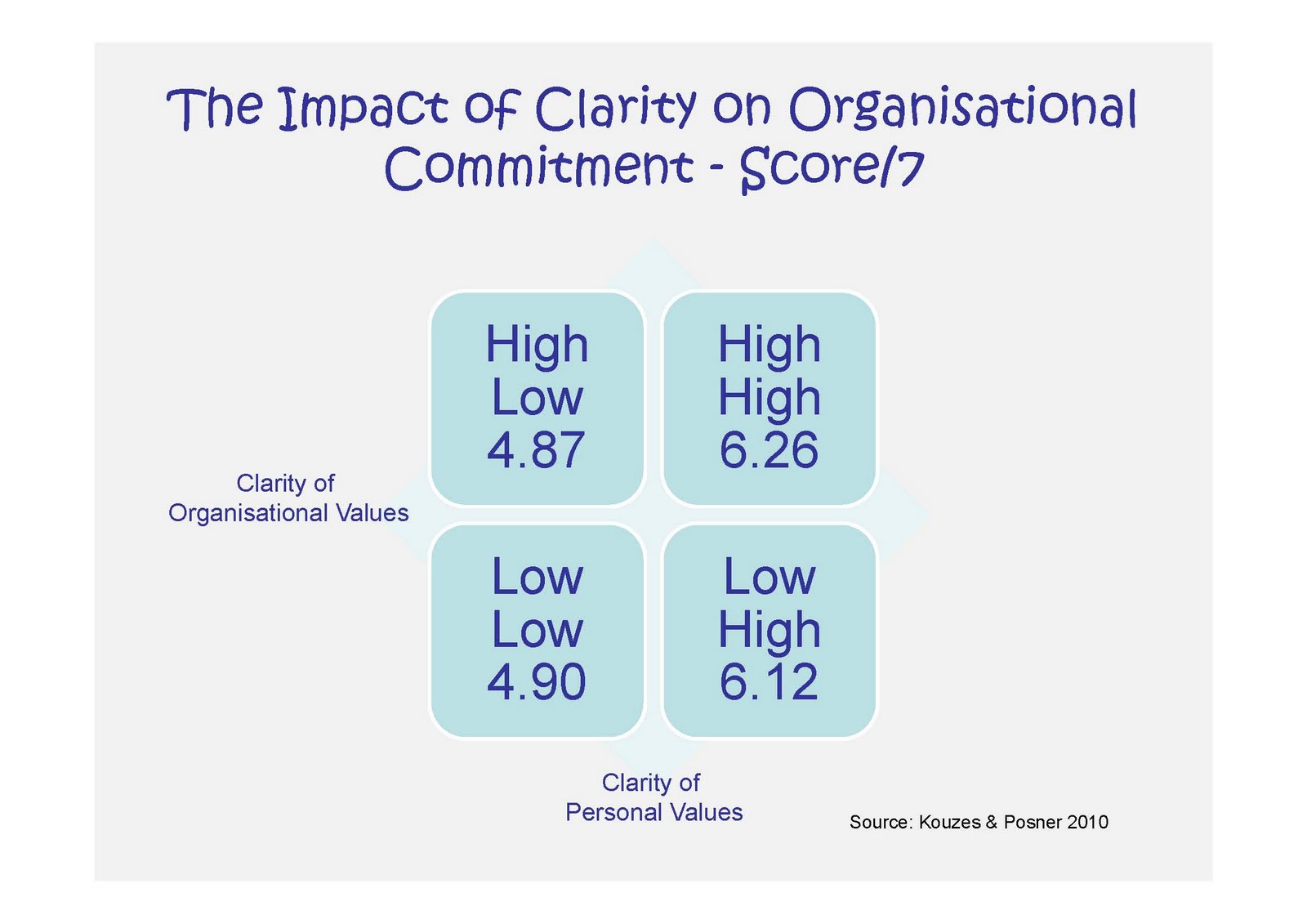
As the illustration highlights (where the highest possible score in any one box = 7), their is no significant difference between the commitment of employees who have both clarity of personal and organisational values compared to those who only have clarity of personal values.

There is however a significant difference in terms of both of those two groups compared to employees who have low clarity of both personal and organsiational values and those employees who have high clarity of organisational values but low clarity of personal values (once again there was no significant difference between these two scores).

So what does this mean in English? It means that it is worth assisting your employees to gain clarity about their personal values. How many organisations do that? Not many from my experience. And while there appears to be no significant difference between just having clarity of personal values and having clarity of both personal and organisational values, it makes sense to me to have both if you can. But the starting point is personal values. Help you employees to know them.

The reality is that it isn’t very hard to help people to clarify their personal values. You just have to know what to do and how to do it.

Within my online community (The OTM Academy) I have a six minute video that helps people to clarify their values, or you can simply follow the instructions laid out in my book What Really Matters For Young Professionals!

Are you clear about your values?

Gary Ryan enables individuals, teams and organisations to matter.
Visit Gary at http://garyryans.com

What Really Matters! Volume 3, Number 3, 2011 ebook out now!

This ebook is a compilation of key articles from the OTM Academy. The articles focus on developing senior and developing leaders who share our view that organisational success is created through enabling people to shine! Contributing authors include Gary Ryan, Ian Berry, Judith Haskins and Troy Simmonds. The ebook design was created by Janine Ripper. Please join the OTM Academy to access more resources.

Gary Ryan enables individuals, teams and organisations to matter.
Visit Gary at http://garyryans.com

Student Ambassadors Develop Their Employability Skills

Congratulations to the Monash University Pharmacy and Pharmaceutical Sciences students who participated in the 2011 Ambassador program. It was a pleasure to work with you all and it is a delight to be able to publish this ebook that highlights your community projects.

Folks these projects have produced a genuine win-win for everyone involved. The students win by having a practical opportunity to develop and enhance their leadership and employability skills, the university wins by having such wonderful Ambassadors engaging with the community and the community wins by having the students provide access to information about university life.

Please view in Fullscreen mode.

Gary Ryan enables individuals, teams and organisations to matter.
Visit Gary at http://garyryans.com

Awkward Workplace Conversations

Thank you to those of you who contacted me because you had seen my contribution to James Adonis’ article on awkward conversations in the workplace (which you can read here.).

It is my strong view that many, if not most awkward conversations in the workplace are made significantly easier if agreed behaviours have been created (and kept alive) throughout a team’s journey. It really does make discussing inappropriate behaviour so much easier because you have your agreed behaviours to which you can refer.

An important point to note is that often we have to experience our agreed behaviours before everyone really does establish a shared meaning for them. As an example some teams that I have worked with have included ‘having fun’ as one of their behaviours. Clearly this can be open to a lot of interpretation. What is fun for some, may not be for others!

This means that you have to experience your agreed behaviours and every once in a while, say once a month, discuss explicit examples of your agreed behaviours in action, including behaviours that you aren’t sure if they fit the intention of your behaviours. These ‘Conversations That Matter®’ don’t have to be long. They can be around 10 minutes which is a small amount of time given the benefits to a team of being on the same page from a behavioural perspective.

Please give the concept a go and share your examples and challenges with our community.

Gary Ryan enables individuals, teams and organisations to matter.
Visit Gary at http://garyryans.com

When sport is more than sport – The Peace Team IC11

The Australian Football League’s (AFL) International Cup 2011 involves 18 male teams and 5 female teams from around the globe competing to become crowned the best AFL country outside Australia.

In 2008 a new team called “The Peace Team” entered the competition. The team comprises 13 Isreali and 13 Palestine players in its squad of 26. They have returned to participate in the 2011 competition (IC11).

This is no ordinary ‘footy team’ and the challenge of putting the team together is no ordinary challenge. Yet the team is here and made it through to the Division 2 semi-finals.

When asked why the team was created, team leaders reported that peace for their homeland was what they wanted. The complexities of creating the team has involved facilitated dialogue sessions because of the long and historic differences between Israeli’s and Palestinians.

I was recently asked, “Gary, when does dialogue work?”

“When all parties choose to dialogue and they share a common purpose, or are willing to discover one.” was my response. The Peace Team is an example of the power of dialogue. Imagine the dialogue that occured to create this team.

While the difference they are making might be small, it IS a positive difference none the less and shows what can be done at any level to improve our world when people have the courage to do so.

You can learn more about The Peace team here.

What efforts are you making to create a more peaceful world; at home, at work and/or in your local community?

Gary Ryan enables individuals, teams and organisations to matter.
Visit Gary at http://garyryans.com

US Postal Service decline highlights why Systems Thinking is critical

‘Systems Thinking’ is a critical leadership skill according to research by the Australian Government that included the Australian Chamber of Commerce and Industry (ACCI) and the Business Council of Australia (BCA). Yet Systems Thinking is only taught in two of Australia’s universities – Monash University and the University of Queensland.

According to a US Government report, The US Postal Service is in peril. In simple business terms its expenses consistently outweigh its income and the gap is getting wider, not smaller.

When the researchers asked for the organisations 10 year plan none was forthcoming. Let’s put the size of this organisation into some perspective. It has 571,566 employees. Imagine the economic and social impact if the US Postal Service was to shut down.

I share this example because it highlights the importance of Systems Thinking. In simple terms Systems Thinking is about understand how everything is connected, that the world does not operate in straight lines and that all systems have limits.

Systems Thinking also teaches us that small changes in one part of a system can have an enormous affect on other parts of the system. We only have to consider our global financial markets to see how this occurs on a daily basis.

In terms of the US Postal Service rather than being proactive regarding significant systemic changes, such as email, they have been reactive. As an example they have consistently relied on ‘First-Class’ mail to subsidise their losses from traditional mail services. Yet their ‘First-Class’ services have been declining at an alarming rate over the past 6 years.

With no plan in place or capacity to ‘see what was coming’ the US Postal Service leaders have failed.
In terms of your development as a leader it is critical that you expose yourself to learning about Systems Thinking, even if you have to lead your own development on this topic. It is one of the reasons I included two chapters specifically on Systems Thinking topics in my book What Really Matters For Young Professionals!
As a start, you might like to review the articles that I have posted on this topic over time. You can access the articles here and here.

Gary Ryan enables individuals, teams and organisations to matter.
Visit Gary at http://garyryans.com

Why the development & recruitment of people lies at the heart of your service strategy

Existing staff need to be developed so that they have the capacity to implement your Service Strategy. This will result in them having the capacity to understand the expectations of their customers and being able to develop appropriate service standards from that understanding.

New staff need to be recruited through processes that identify their alignment with your Service Strategy. This means that the organisation’s recruitment processes must reflect a process that is seeking the best possible people that it can find so that its Service Strategy can be implemented.

The result is a virtuous cycle that re-enforces great service. When people love their work they attract other high quality to want to work with them too. The reverse is also true. The wrong people in the wrong jobs who end up hating what they do don’t provide great service. How could they!

How do your development and recuitment practices support the establishment of a virtuous cycle for great service in your organisation?

Why not use this article to stimulate Conversations That Matter® with your team.


©Copyright Gary Ryan 2011

Research Participant
Our recruitment policy used to be, “Do you know anyone who has a heartbeat and is available?”. Me, I’d been here 20 years and had never been on any training. I never realised how bad we were until I honestly thought about whether I’d like to be a customer of my own team. My answer was no!

Gary Ryan enables individuals, teams and organisations to matter.
Visit Gary at http://garyryans.com

Expert Tip – Motivation Factor 10

In the eleventh and final short video in the 11 part series on how to create motivated employees, I share the last of 10 key factors that when present will collectively enhance the motivation of your team members/employees.

How do you rate for this factor? How does your employer rate for you?

Gary Ryan enables individuals, teams and organisations to matter.
Visit Gary at http://garyryans.com

Expert Tip – Motivation Factor 9

In the tenth of the short videos in the 11 part series on how to create motivated employees, I share the ninth of 10 key factors that when present will collectively enhance the motivation of your team members/employees.

How do you rate for this factor? How does your employer rate for you?

Gary Ryan enables individuals, teams and organisations to matter.
Visit Gary at http://garyryans.com