Category Archives: Leadership

Who is The Customer?

Many people don’t like the term ‘customer service’ for good reason. However, this doesn’t mean that the principles of ‘service excellence’ don’t apply to how they go about doing their work. Gary Ryan explains how ‘service excellence’ enables you to exceed expectations no matter what you call your ‘customers’.

Many people get hung up on the word ‘customer’. This is the challenge with the concept of ‘customer service’ because many people think that they don’t have ‘customers’. And maybe they don’t. Maybe they have clients, colleagues, administrators, staff, stakeholders, lawyers, doctors, labourors, community members, students, guests and any other label that you can think about. The issue is not the label; the issue is the ethic behind how you treat people.
Another way of looking at it is to say that ‘the customer’ is anyone who receives the output of your work. Anyone.
This is why we prefer the term, “service excellence” over “customer service”. Unfortunately many people think that they don’t have ‘customers’ (because they use a different term) so they conclude that service has nothing to do with them. But it has everything to do with them. Everyone is your customer. Everyone.

Copyright Gary Ryan 2011

Research Participant
You know that I can’t stand the word ‘customer’. The people I serve are staff, not customers. I find out what they want and I do my best to exceed their expectations every time. So I wish people would stop saying that I have to be ‘customer’ oriented. I’m staff oriented and that is what is important!

Gary Ryan enables individuals, teams and organisations to matter.
Visit Gary at http://garyryans.com

Gap 4 – The Market – Communication Gap

If you say that you will respond to online customer feedback within 24 hours and you consistently take 48 hours to do it, then you have created a Market – Communication Gap.

The local barber who cuts my hair has two signs out the front of his barber’s shop. One sign says that the shop will be open at 8:30am. The second says 8:45am. The barber is rarely there before 9am. He has no idea how many people have looked in his window when he wasn’t open when he advertised that he would be.

My expectations are consistently not being met. One day a new barber/hairdresser will move into an empty shop in the shopping strip. What do you think I will do?

What Market – Communication Gaps are you creating?

Why not use this article to catalyse Conversations That Matter® within your team or organisation.

Copyright Gary Ryan 2011

Quote from the barber

Sorry mate. I know that I said sorry the last couple of times but my car broke down and I had to wait for my wife. Sorry mate.
Gary Ryan enables individuals, teams and organisations to matter.
Visit Gary at http://garyryans.com

What is your service-quality gap?

Gap 2

It is one thing to be able to understand the expectations of those you serve. A gap can emerge if your translation of those expectations into service standards is inaccurate.

Service standards are effectively the systems and processes that you put into place to ensure that you can consistently meet the expectations of your customers. This is very easy to get wrong and requires a high understanding of the expectations of your customers, as well as a high level of understanding of how your organisations works if you are to minimise this gap. Hiring the right people with the passion to serve, and supporting them with appropriate service standards is critical for minimising this gap.
Copyright Gary Ryan 2011
Research participant
The members said that they wanted the gymnasium to open at 6am. So I employed the staff to start their shift at 6am. The members were still not happy. I was confused. When I asked them again why they weren’t happy they said, “We told you that we wanted the gym open at 6am, not ‘opening’ at 6am. There’s a difference!” Finally I understood. The staff would be paid to start at 5:45am so that the gym would be truly open as had been requested. I had been wrong. I had misinterpreted the expectations of the members.
Gary Ryan enables individuals, teams and organisations to matter.
Visit Gary at http://garyryans.com
5 Star and 2 Star service can both be great, or not!

Gary Ryan provides a practical example that highlights how 5 Star and 2 Star service levels can be both good and bad. How good is the level of service that you are providing? Is it great?

Many people think that good service is only provided ‘at the top end’ of the service star scale. In other words, if I’m running a 2 star motel then only a low level of service should be provided. In the context of WHAT is provided and WHAT is paid, this is true. But the service experience can still be above expectations. 
For example, the person greeting me may be genuinely happy to check me into my room. When provided directions to my room I am asked if I am interested in knowing where some cheap but good quality food can be found. In responding yes to that question I am provided with the appropriate information, which includes a range of discounts should I choose to eat at those places. (Later, when I do choose to eat at the place, my discount is honoured and the food is reasonable for what I have paid for it).
I go to my room, the key works and my room is fresh and clean. I have asked for a non-smoking room and there is no evidence that the last person who used it smoked like a chimney. The information booklet is up to date and includes relevant information about public transport, taxis, health clubs and eateries. When I check out the staff member is courteous, quickly processes my payment and bids me farewell.  If you wish to consider a poor ‘2 Star’ experience, simply go back over this story and reverse each experience that has been described.
It would not be very difficult to translate this ‘2 Star’ story into a ‘5 Star’ story. The differences in the experience will relate to what we have paid and what we then expect to receive in return. The room may be bigger. The location may be more convenient. The bed may be bigger with higher quality linen. Internet access may be available. The fixtures and fittings may be of higher quality. An on-site restaurant and 24 hour in room service may be available. Laundry services may be available and a concierge service may be available to assist us with any needs or enquiries that we may have regarding the hotel of surrounding area. 
Each ‘Moment of Truth’ (MoM) can contribute to our expectations not being met if the experience of the MoM is not up to our expectations. In this way, 2 Star service can be great service and 5 Star service can be poor service. It all depends on the perceived experience of the customer.
Copyright Gary Ryan 2011
 
“Visits are not limited to the public areas. I head for the heart of the house, too. There’s method to my madness. If I see smiling faces and well-scrubbed surfaces behind the scenes, I know that the rest of the hotel more than likely is doing just fine.” 
J.W.Marriott Jr from his book, ‘The Spirit to Serve’
Gary Ryan enables individuals, teams and organisations to matter.
Visit Gary at http://garyryans.com

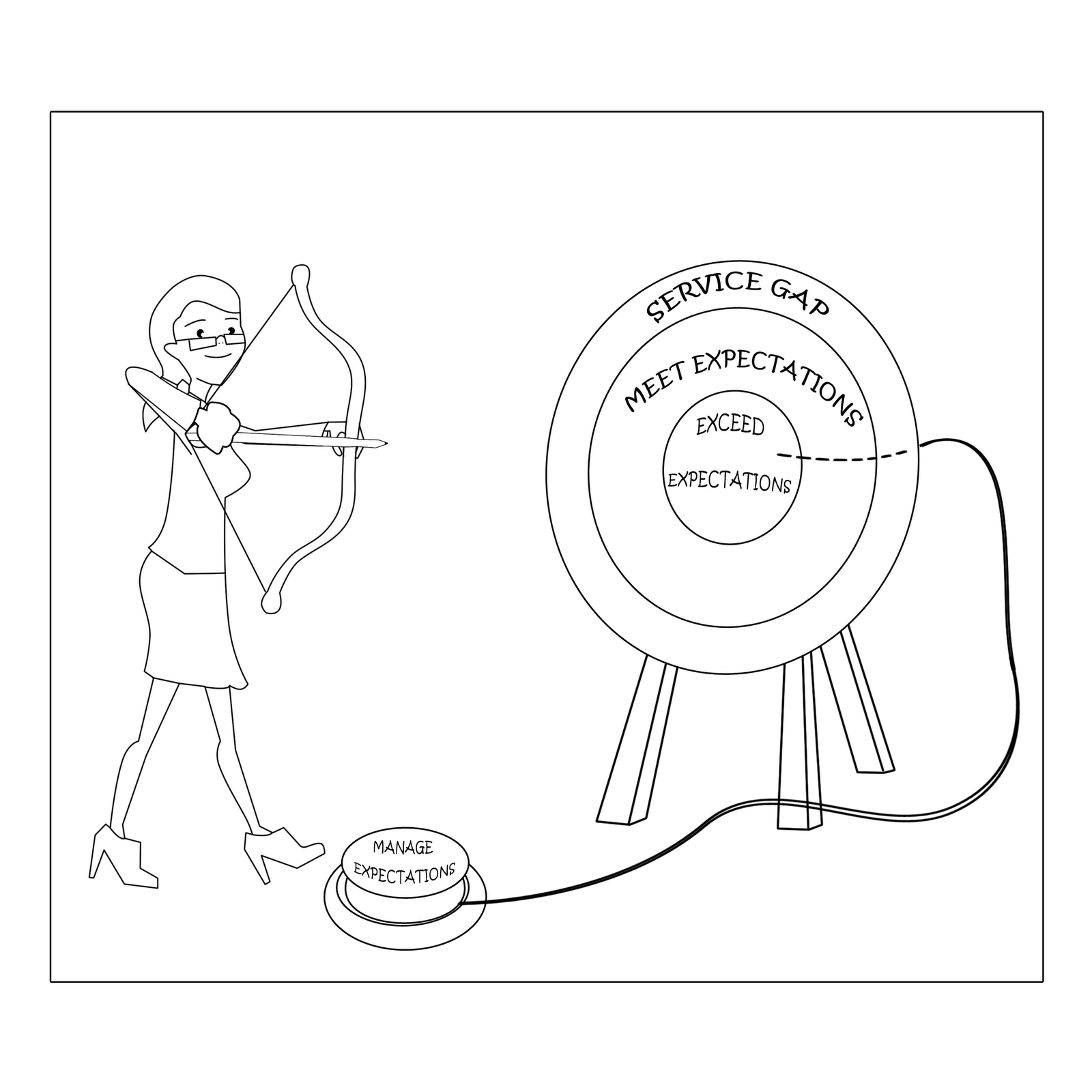
If you want to provide great service, exceed expectations!

People expect good service. Period. Often, their expectations are not met. Too often. Just think about your own experiences as a customer. How often are your expectations met? How often are they exceeded? 

Customers expect their expectations to be met. You expect your pay to arrive when it is due. You expect your food to be delivered as ordered within a reasonable timeframe and at the appropriate temperature when you order food at a restaurant or cafe. You expect finance reports to be delivered and inclusive of all appropriate information as scheduled. You expect to be treated as a human being when you visit a government agency, education institution or medical facility. 

In order to be able to consistently meet expectations, your organisation must aim to exceed expectations. It is likely that there will nearly always be a lag between when you last checked the expectations of those you serve and the actual service that you are providing them. The lag time may include a change in the level of expectations of those you serve. 

Unless you are aiming to exceed the expectations at the level that you understand them to be, you may not achieve a consistent level of meeting the expectations that you do know exist. This never-ending journey means that exceeding expectations is a challenge. A real challenge. A challenge worthy of your commitment. Is your organisation currently worthy of your commitment?

Managing expectations is part of the OTM Service Strategy®

 “Consistently exceeding the expectations of the customer, personalizing his or her service experience, and continuously improving your product or service so that it creates greater value for the customer produces a level of customer loyalty that cannot be matched by your competitor.” 
Theo Gilbert-Jamison, service excellence expert/author

Gary Ryan enables individuals, teams and organisations to matter.
Visit Gary at http://garyryans.com

Rocket scientists beware, good service is good business!

It really isn’t rocket science, but in highly competitive times it makes sense that good service is good business. Even though customers are not particularly loyal, providing great service consistently and over a long period of time makes it all the more difficult for your competitors to attract your customers away from you. 
While your customers will try out the competition, if they do not receive a higher and consistent standard of service than your organisation provides, then your customers will come back and be less inclined to try out the competition again. Implicitly your customers will trust you (just as you, in turn, trust your staff). 
It is however, good practice to maintain a healthy tension about your customers trying out the competition. The day that you either think that you don’t have any competition, or the day that you stop providing good service on a consistent basis, is the day that your organisation will start to decline.
No job is secure. But good, consistent service increases the security of every job, every department and every organisation. Good service IS good business!
Good service is good business
Quote from a research participant
Great service actually feels good. It feels good for me, it feels good for the people I’m serving and it keeps the business humming along. To me, good service just makes sense.
Gary Ryan enables individuals, teams and organisations to matter.
Visit Gary at http://garyryans.com
If you think that 8M Australians with poor job skills means you are guaranteed a great career, think again!

A report by Australia’s Industry Skills Councils to the Australian Federal Government has warned that up to eight million Australians don’t have the necessary numeracy and literacy skills to train for a trade or a profession.

The Report provides both bad & good news

The report also notes that over the next five years Australia will experience an estimated shortage of 215,000 skilled workers.

On the surface this may look like statistics that are extremely positive for current professionals and skilled employees. Why? Because the statistic highlight how poor the competition for skilled and professional jobs is at this point in time.

There is little to argue against this fact.

However, skilled workers and professionals need to think again. The lack of a skilled workforce and the extremely high number of people with low numeracy and literacy skills will increase the pressure on current skilled workers and professionals. Why? Because they are going to be the ones leading and managing the rest of the workforce. So the requirement for highly developed leadership and management skills are going to be paramount.

Getting and job and staying in employment for skilled workers and professionals will be virtually guaranteed (providing you are prepared to go where the work is located), however this doesn’t guarantee a great career. You will absolutely need to continue to develop your skills and employability so that you have the skills sets to lead and manage the rest of the workforce. These skill sets will continue to grow in demand and it is the people who really know how to lead and manage, and can demonstrate their skills through their track record will be the ones who will be “guaranteed” a great career.

What are you doing to enhance your leadership and management skills even if you have been leading and managing for a long time?

Gary Ryan enables individuals, teams and organisations to matter.
Visit Gary at http://garyryans.com

Is there something wrong with me? I don’t seem to be able to answer questions about my vision

Guiding people through the process of creating their OTM Plan for Personal Success is one of the most rewarding aspects of my work.

I especially enjoy helping people who have the courage to ask questions when they are ‘stuck’ throughout the process that I guide them through.

Tonight a participant in the program I was conducting asked me if there was something wrong with her because she hadn’t been able to answer the questions that I had been asking that are designed to help people to work out their personal vision.

Sometimes up to one third of program participants report this challenge. Which is why it was so important that that Lilly asked her question. You see, in answering Lilly’s question other participants were also able to ‘unblock’ themselves from their challenge.

When I inquired with Lilly about why she had struggled to answer the questions, I discovered that Lilly had been letting her present reality ‘get in the way’ of defining, and physically writing down what she really wanted. This is common. Our present reality is so ‘real’ that it can be very difficult to set it aside and write down what we really want.

Fortunately I was able to help Lilly see past this challenge so that by the end of our short conversation she was flowing with answers that related to her personal vision.

When we create a personal plan for success we have to focus on what we want. After all, who is going to put into action strategies that are going to create who you don’t want? Not me, that’s for sure.

Finally, creating a personal plan is like any skill. The first time we do it we are not as good as we’d like to be. This is normal. Which is why personal planning needs to be practiced and, especially in the first years of living your OTM Plan for Personal Success, I recommend updating your plan every six to 12 months.

If you are interested in creating an OTM Plan for Personal Success, why not check out the free 40 minute webinar that I am hosting on this topic.

Gary Ryan enables individuals, teams and organisations to matter.
Visit Gary at http://garyryans.com

If you were a CEO would you run 260kms for your philanthropic organisation?

Well, that is exactly what Adrian Panozzo, OTM Academy member and CEO of Reclink is doing!

Adrian is hoping to raise $10,000 for Reclink by completing the Marathon de Sable which commences on April 1st. Over seven days Adrian will have to carry his own food and water across the desert. Please support Adrian as Reclink is a charitable organisation whose mission is to provide sporting, social and arts activities to enhance the lives of people experiencing disadvantage.

Donations can be made here.

Gary Ryan enables individuals, teams and organisations to matter.
Visit Gary at http://garyryans.com

Russell Ackoff shares the fundamentals of Systems Thinking

Russell Ackoff is a champion of Systems Thinking and one of the most respected experts on this topic while he was alive.

The Australian Government recognises Systems Thinking as a critical skill that relates to leadership. Yet very few people know what Systems Thinking is.

In the two short videos below, Russell explains the history and fundamental principles of Systems Thinking.

After viewing the videos, consider how Systems Thinking affects how you see the world and how it works, particularly with regard to how organisations work.

Part 1

Part 2

Gary Ryan enables individuals, teams and organisations to matter.
Visit Gary at http://garyryans.com