Category Archives: Leadership

How should a Team Leader in a poor company culture improve team member motivation?

Unfortunately poor company cultures exist. This is why Organisations That Matter was created – to try, one company at a time, to change this reality.

So, what can a Team Leader do to improve the motivation of their team members when their team exists within a poor company culture?

The first thing is to control what you can control as the Team Leader. My experience and research indicates that pay is a massive de-motivator if it is not ‘fair’ in the overall context of pay within the company and the industry that you are in. If a person is not being paid fairly in this context, then pretty much everything else that the company does becomes less relevant over time. The pay issue becomes the core de-motivational issue.

If pay is ‘unfair’ then you must do what you can to fix that situation.

Most companies have systems and processes for accurately paying people. As such, if you believe that a person is being paid unfairly, go in to ‘bat’ for them. Let them know what you are doing but also let them know that you have to follow the system’s rules. Providing you have a record of being genuine, most people will be very pleased that you have taken the time and effort to go in to ‘bat’ for them. This act of support will often increase a person’s motivation. However it won’t last forever if the real problem isn’t addressed. (Please note I accept that the research indicates that most people feel they are underpaid. However, when ‘pay’ is placed in the context of company and industry, it is my experience that most people are able to identify if they are paid within an acceptable ‘range’ of pay.)

If pay is ‘fair’ then it is the cultural issues that come into play. It is possible, within limits, to create a positive sub-culture that may exist only in your team.

From my research from conducting many leadership development activities on this exact issue, the simultaneous things that you can do are very controllable.

You can genuinely appreciate and recognise the efforts of your team members. This starts with saying, “Thank you.”

You can look out for developmental opportunities (including projects) and offer them to your team members.

You can listen to their suggestions and genuinely take them on board and then get back to them about why their idea has/hasn’t been implemented.

You can assign tasks to team members that truly reflect their talents while at the same time creating some ‘stretch’ for them. Of course, this means that you will have bothered to find out what their talents are!

You can create team celebrations to celebrate successes.

You can bother to remember the whole of life details that your team members have felt comfortable sharing with you (ie their partners and/or children’s names, their birthday, special events in their life, their sporting teams and heroes etc.)

You can articulate how your team is contributing to your organisations vision and mission and help each person to ‘see’ how they are personally contributing to bringing these to life.

When times demand it you can make decisions that are timely and help the team to achieve its objectives.

These actions are all doable and are well within the control of a leader, irrespective of company culture.

It is my experience that when these activities are done with genuine intent, most people respond with an increase in self motivation and perform to a higher standard which is ultimately what leadership is trying to achieve.

How have you worked to increase the motivation of the members in your team?

Gary Ryan enables individuals, teams and organisations to matter.
Visit Gary at http://garyryans.com

Awareness matters!

The scene
I had been asked to attend a late afternoon meeting with a client in a different part of the city to which my office is located. I decided to drive to the meeting so that I could drive home. As luck would have it, a one hour metered carpark was available immediately outside the client’s building.

Upon arrival the receptionist asked where I had parked. I informed her that I had parked in the one hour zone out the front of the building.

I was shown to the meeting room and some cool, fresh water was provided. I was informed that the person I was meeting had been held up in another meeting off-site and was on his way, possibly being 30 minutes late.

The moment that mattered

Prior to the arrival of my client, the receptionist popped her head back into the meeting room and asked whether it would be okay for her to pop downstairs to ‘feed the meter’ for me.

I had started to wonder how I was going to manage the parking situation given that a large period of my 60 minutes had been ‘chewed up’ waiting for my client to arrive. The awareness of the receptionist, Crystal, to help me was just terrific. Crystal realised that I might be starting to worry about my car and that the parking issue could end up being a problem for me should the meeting last longer than the now available 30 minutes.

To me Crystal’s actions highlight the importance of awareness and how it is directly linked to service excellence. Crystal could not control whether my client’s availability, but she was able to control her awareness to relieve a problem before it occurred.

That is exactly what awareness does. It ‘heads problems off at the pass’, before they have a chance to take effect.

What are your examples of how awareness has both enhanced service excellence and resolved a problem before it occurred?

Gary Ryan enables individuals, teams and organisations to matter.
Visit Gary at http://garyryans.com

Teams That Matter Webinar Recording

Webinar Recording, November 2010.
Gary Ryan introduces the seven key elements for creating Teams That Matter. High performing teams are rare, but they don’t have to be. Discover the key elements that will help you to create a high performing Team That Matters.

Please contact me if you would like to learn more about how I can help you create a Team That Matters.

Gary Ryan enables individuals, teams and organisations to matter.
Visit Gary at http://garyryans.com

Why workplace trust is a challenge

The challenge with workplace trust, whether from leaders to employees or employees to leaders or employees to employees is that to trust another person you must be willing to be vulnerable. That is, the act of trusting someone means that you are openning yourself up to the ‘risk’ that whoever you are trusting could ‘break’ your trust.

You see, trust cannot be broken unless it is given in the first place.

This is one of the factors that makes trust within an organisation so hard.

Whether this be from leader to employees, or from employees to leaders. The same is true.

In this context leaders must be able to demonstrate that they are willing to be vulnerable by trusting employees, and employees need to demonstrate that they too are willing to be vulnerable by trusting their leaders.

I’m suggesting that trust is built by demonstrating trust and being open to the vulnerabilities that come with trusting others.

What are your experiences of organisational trust?

Gary Ryan enables individuals, teams and organisations to matter.
Visit Gary at http://garyryans.com

How great service attracts requests for a broader range of products/services

In much the same way that great service attracts new customers, it also attracts existing customers to enquire about new services/products that may be provided by the organisation. Consulting firms in particular are familiar with this phenomenon. Satisfied clients will request if new services can be provided before seeking another consulting firm to supply the service. This can help an organisation grow.

A word of warning.

Just because a customer asks your organisation to provide a new service or product doesn’t mean you should do it. As long as the new service or product fits with your organisational purpose and will continue to take the organisation towards its desired future and the organisation has the capacity to provide the new service, then it should do it. Otherwise it should refer the customer elsewhere. This too is great service.

How is delivering great service increase resulting in requests for ‘more’ from your clients/customers?

Client quote
Because of the great job that you did with our leadership training I was wondering if you could assist with improving our inter-departmental relationships? I thought that I’d check with you first before trying out some of our other suppliers.

Gary Ryan enables individuals, teams and organisations to matter.
Visit Gary at http://garyryans.com

Service enables us to identify our customers

Your customers can be colleagues, your supervisor, the staff who report to you, the people and/or organisations to whom you provide services, the people who pay for your services or products even though others may use them. Often your service or product will have multiple layers of customers. The customers who actually use your service or product may be different from the customers who purchase your service or product. A service focus helps both you and your organisation to identify and differentiate the expectations of these different customer segments. If you don’t get this right, you may be left with no customers at all.

Understand your customers across the multiple levels of service you provide. Do you understand yours?

Quote from a research participant
“I first thought that this service training stuff was a load of, well, you know! But it got me thinking. Who are my customers? Funnily the first person who’s head popped in my mind was my boss’s. I’d never really thought of my boss as a customer. Yet, she probably is.”

Gary Ryan enables individuals, teams and organisations to matter.
Visit Gary at http://garyryans.com

Why Creative Tension Trumps Problem Solving

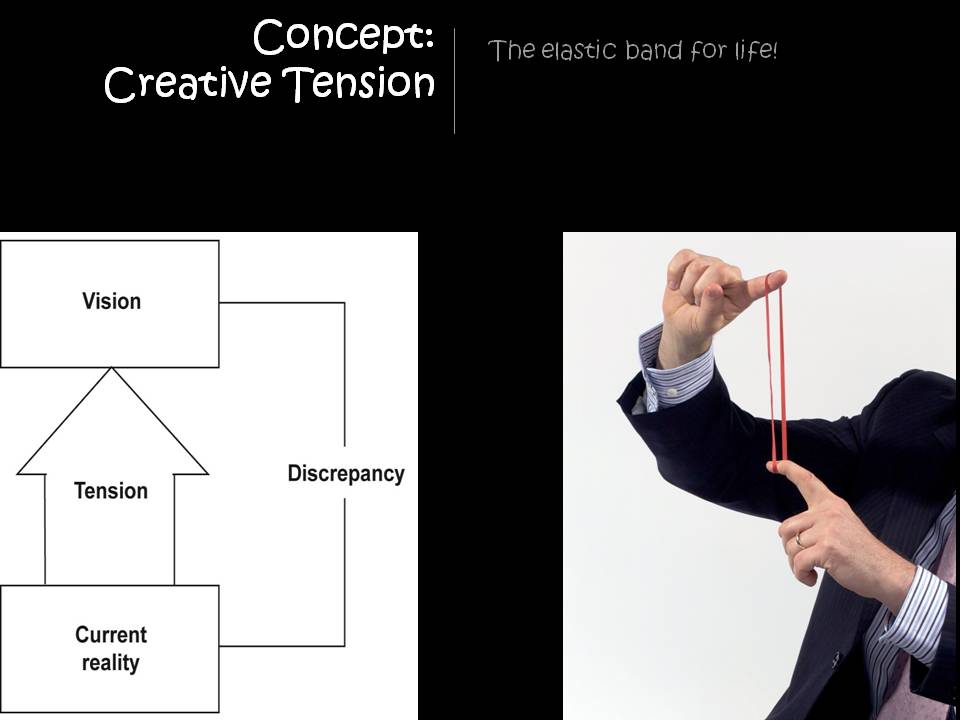
Creative Tension involves three simple concepts that, when put together, create a structure that provides the energy for effective action. Many of you will have seen me refer to the ‘elastic band’ metaphor (see TEDx Talks – Creating a Plan For Personal Success) that enables us to create the life we desire.

You see, Creative Tension is about creating what we want. Problem Solving, on the other hand, largely focuses on what we don’t want.

Artists tend to use Creative Tension while people in business tend to use Problem Solving. My argument is that business people should follow the practices of artists and also focus more on using Creative Tension rather than Problem Solving.

Artists
Imagine that Pink has decided to write a new album. What approach do you think would provide Pink with the biggest probability of creating an album full of smash hits.

a) To take the approach that at the start of the writing process that she has a problem to resolve. The problem is, “I don’t have any new songs ready to put on my album.”

To resolve this problem Pink may recruit a bunch of her musician friends and brain-storm a heap of ideas that they believe would be likely to eventually generate the ‘right’ songs for her album. As each song is recorded Pink’s problem would reduce because she would now have some songs for her album. Finally Pink would finish her album and release it to the public.

b) To take that approach that an album is a work of art and that the art requires some form of inspiration. Focusing on the quality of the album that she wishes to create, Pink would generate a number of experiences to enable her to fully picture what the album will be like.

Once the ‘direction’ of her album is clear, Pink would then recruit artists to help her to bring her ‘picture of success’ into reality. The number of songs on the album and the length of the songs would all fit into Pink’s vision of what the album was going to look like. Eventually, Pink would ‘create’ the album that she desires.

Music, art and films are all treated as creations to be made rather than problems to be solved. Alfred Hitchcock is famously reported to have refused to let his writers ‘close out’ a story line too early. Instead, Hitchcock would prefer to ‘hold the tension’ of an unfinished storyline so that true creativity amongst he and his writers could be inspired. The result; Hitchcock became one of the greatest film directors of all time and is still known today for creating stunning plots, scenes and movies.

Business people
Business people want to be successful, just like artists do. However business people are trained to see problems and to focus on fixing those problems. Common problems that business people try to fix include:

* The problem of under-performance
* The problem of low motivation in employees
* The problem of maintaining efficiencies
* The problem of low supply and high demand
* The problem of high supply and low demand
* The problem of not enough resources
* The problem of poor communication
* The problem of poor internal service
* The problem of poor external service

Really, this list could go on and on, but I think you ‘get’ the picture.

Business people use the same approach to these problems as described in ‘a’ above for the artists. They gather a group of colleagues, brainstorm a bunch of ideas to resolve the problem, select the ‘best’ answer and then implement that answer in the hope that the problem is resolved.

Usually the ‘best answer’ does have an impact on the problem and it does reduce in its intensity. As this occurs and the original problem is less of a problem, less effort is put into resolving the problem. Why? Because now other, more serious problems require focus. And so the process goes, on and on and on. A bit like a dog chasing its tail!

What if, on the other hand, business people learnt to focus on what they are really trying to create? Rather than focusing on problems that need to be resolved, what if business people focused on the customer experience, the employee experience, the community experience of their service or product? And what if this focus was present at all levels of the organisation?

There is a difference between art and business
Art is generally not released to the public until it is created. In many ways art is created in a vacuum. Once created it is then released. Business is different. Much of what goes on in a business can’t be placed into a vacuum until it is created. The way the world works simply won’t allow it. In business we ‘change the wheels on the bus while the bus is driving down the road’.

It is for this reason that problem solving, in a business context is still relevant. There are some problems that simply have to be resolved. Such as an unhappy customer ‘right now’. However, what if problem solving in a business was provided within the context of Creative Tension? In other words, what if the experience that we are trying to create for our customers, or the experience and culture that we are trying to create for our employees was the guiding force for our strategy, actions and problem solving?

Creativity is challenging because of the tension that is generated when we become clear of what we want, but have no idea of how to bring what we want into reality. Artists experience this tension all the time and have learned to embrace it. Business people on the other hand are scared out of their minds when they don’t know ‘how’ to bring the future they desire into reality. This is why most business people focus on Problem Solving rather than Creative Tension. Problem Solving is simply more comfortable. “We know ‘how’ to problem solve. We don’t know ‘how’ to create.”

If you are not sure of what I mean you might like to view the video The Gates (below). As you watch the short video, consider the power of Creative Tension that went in to bringing the vision of art on such a large scale into reality.

How present is Creative Tension in your organisation? What are your examples?

Please feel free to comment on this article.

Gary Ryan is a founding Director of Organisations That Matter and can be most easily contacted at Gary.Ryan@orgsthatmatter.com .

I would like to recognise Robert Fritz whose writing over the past two decades has inspired my thinking and practice on this topic.

Gary Ryan enables individuals, teams and organisations to matter.
Visit Gary at http://garyryans.com

Is your message and the experience you create aligned?

This really isn’t rocket science but I am continually amazed at how many organisations get this wrong. Recently my family have been doing high school tours to help us make a decision regarding the right school for our eldest child.

The schools have had many different approaches to this process. However, their messages have been very similar, “We create a caring, belonging and nurturing environment for your child where we seek to create well rounded young adults with strong academic and life skills.”

Yet it is our experience of this message that has stood out the most for us. One school that had over 900 students crammed us into a room where three teachers and three students spent 60 minutes ‘telling’ us about the nurturing and sense of belonging that the school creates. The speeches were fine, the images shown to us on the Powerpoint presentation also looked fine.

The teachers then stayed in that room while the three students led over crowded tours around the school. Classrooms were closed, it had become dark and lights were off and we spent most of the time peering in through windows trying to get a sense of what the school was like.

After a while the litter on the ground became more and more noticeable. After all, there wasn’t much else to see or experience.

It seems to me that if you are going to promote a sense of belonging, then that is the ‘experience’ that you should do your very best to create. This is a classic case of ensuring that your message and the experience you create are aligned. All it takes is a few moments to ask this question, “Is the experience we are going to create aligned with our message?”

The school I have described is no longer on our list. Other parents who have also visited the school for their tours have expressed similar concerns. The school is completely unaware of the misalignment between their message and the experience they are creating.

How do you make sure that your message and the experience you create are aligned?

Gary Ryan enables individuals, teams and organisations to matter.
Visit Gary at http://garyryans.com

Service helps us make sense or our strategy at the day to day level

Business strategy focuses upon enabling an organisation to move from its present state to a desired future state. It provides the ‘roadmap’ for this movement. Ultimately this results in thousands upon thousands of actions happening throughout the organisation. The intention of these actions is to move the organisation in the desired direction that the strategy dictates.

Each action is therefore an example of the organisation’s ‘strategy in action’. A clear service focus enables these actions to ‘make sense’ in the context of the overall business strategy and can help to connect the people within the organisation to the business strategy on a day to day, action by action level.

Quote from a research participant
When I understood that all I had to do was to focus on understanding the expectations of the people I serve, the whole service thing became a lot clearer. I’m not into big words and I’m not a manager, but I can find out what people expect of me and do my best to fulfil those expectations.

Gary Ryan enables individuals, teams and organisations to matter.
Visit Gary at http://garyryans.com

TEDx Talks Plan For Personal Success by Gary Ryan

Keynote speech for TEDx Talks at NAB, Docklands Australia on Thursday 21st October 2010.

Gary Ryan, founder of Organisations That Matter explains the underlying concept and five principles and six vital strategies for creating a Plan For Personal Success.

Please visit here to discover more about our options for creating a Plan For Personal Success.

Gary Ryan enables individuals, teams and organisations to matter.
Visit Gary at http://garyryans.com