Category Archives: Personal Vision

Is there something wrong with me? I don’t seem to be able to answer questions about my vision

Guiding people through the process of creating their OTM Plan for Personal Success is one of the most rewarding aspects of my work.

I especially enjoy helping people who have the courage to ask questions when they are ‘stuck’ throughout the process that I guide them through.

Tonight a participant in the program I was conducting asked me if there was something wrong with her because she hadn’t been able to answer the questions that I had been asking that are designed to help people to work out their personal vision.

Sometimes up to one third of program participants report this challenge. Which is why it was so important that that Lilly asked her question. You see, in answering Lilly’s question other participants were also able to ‘unblock’ themselves from their challenge.

When I inquired with Lilly about why she had struggled to answer the questions, I discovered that Lilly had been letting her present reality ‘get in the way’ of defining, and physically writing down what she really wanted. This is common. Our present reality is so ‘real’ that it can be very difficult to set it aside and write down what we really want.

Fortunately I was able to help Lilly see past this challenge so that by the end of our short conversation she was flowing with answers that related to her personal vision.

When we create a personal plan for success we have to focus on what we want. After all, who is going to put into action strategies that are going to create who you don’t want? Not me, that’s for sure.

Finally, creating a personal plan is like any skill. The first time we do it we are not as good as we’d like to be. This is normal. Which is why personal planning needs to be practiced and, especially in the first years of living your OTM Plan for Personal Success, I recommend updating your plan every six to 12 months.

If you are interested in creating an OTM Plan for Personal Success, why not check out the free 40 minute webinar that I am hosting on this topic.

Gary Ryan enables individuals, teams and organisations to matter.
Visit Gary at http://garyryans.com

Free Webinar – An Introduction To The OTM Plan For Personal Success Program

Do you have a detailed plan for personal success?

Have you defined what ‘Life Balance’ means for you?

Have you got clear strategies for creating the life you desire?

Gary Ryan presents an introduction to the OTM Plan for Personal Success program.

In this interactive webinar you will learn about:
* The core concept that underpins personal success
* Five key principles for personal success
* Six vital strategies that are essential for taking effective action

You will identify your Personal Success Team and much, much more.

Seats are limited so register now for your Complimentary Code to attend this webinar for free.

Gary Ryan enables individuals, teams and organisations to matter.
Visit Gary at http://garyryans.com

An Introduction To The Discovering Your Personal Values Activity

As a result of an impromptu request from audience participants after his TEDx Talks ‘Plan For Personal Success’ keynote, Gary Ryan facilitated an exercise to help staff identify their personal values.

This short video includes the introduction piece to this activity.

Please Contact Us if you would like to speak with Gary regarding discovering more about personal values or facilitating a program for your staff.

The complete exercise is included in Gary’s new book What Really Matters For Young Professionals!

Length: 6 mins

Gary Ryan enables individuals, teams and organisations to matter.
Visit Gary at http://garyryans.com

Why Creative Tension Trumps Problem Solving

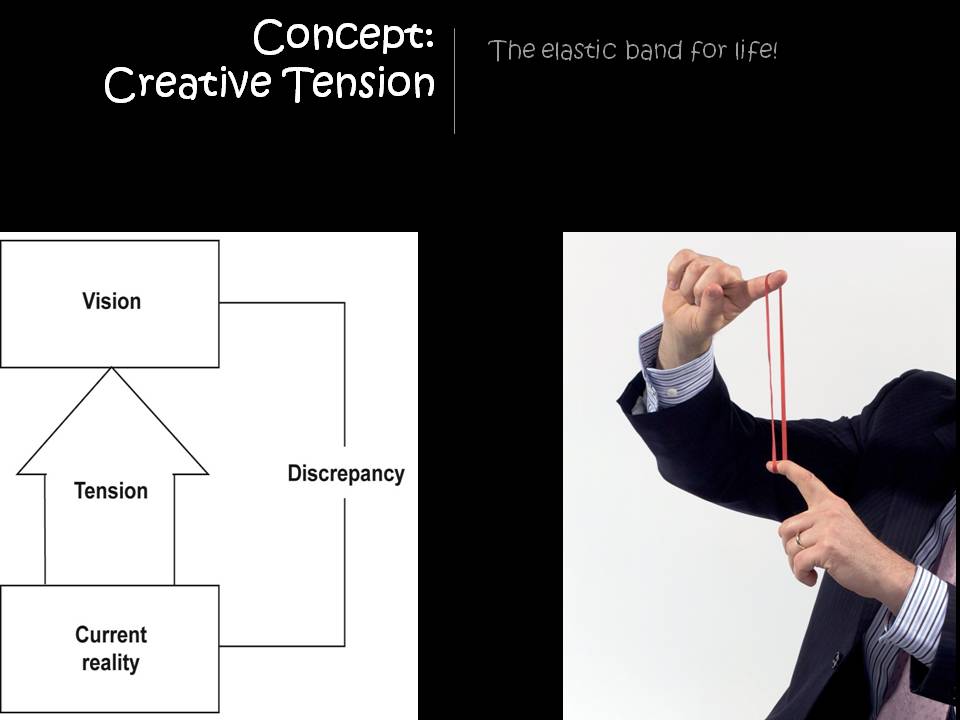
Creative Tension involves three simple concepts that, when put together, create a structure that provides the energy for effective action. Many of you will have seen me refer to the ‘elastic band’ metaphor (see TEDx Talks – Creating a Plan For Personal Success) that enables us to create the life we desire.

You see, Creative Tension is about creating what we want. Problem Solving, on the other hand, largely focuses on what we don’t want.

Artists tend to use Creative Tension while people in business tend to use Problem Solving. My argument is that business people should follow the practices of artists and also focus more on using Creative Tension rather than Problem Solving.

Artists
Imagine that Pink has decided to write a new album. What approach do you think would provide Pink with the biggest probability of creating an album full of smash hits.

a) To take the approach that at the start of the writing process that she has a problem to resolve. The problem is, “I don’t have any new songs ready to put on my album.”

To resolve this problem Pink may recruit a bunch of her musician friends and brain-storm a heap of ideas that they believe would be likely to eventually generate the ‘right’ songs for her album. As each song is recorded Pink’s problem would reduce because she would now have some songs for her album. Finally Pink would finish her album and release it to the public.

b) To take that approach that an album is a work of art and that the art requires some form of inspiration. Focusing on the quality of the album that she wishes to create, Pink would generate a number of experiences to enable her to fully picture what the album will be like.

Once the ‘direction’ of her album is clear, Pink would then recruit artists to help her to bring her ‘picture of success’ into reality. The number of songs on the album and the length of the songs would all fit into Pink’s vision of what the album was going to look like. Eventually, Pink would ‘create’ the album that she desires.

Music, art and films are all treated as creations to be made rather than problems to be solved. Alfred Hitchcock is famously reported to have refused to let his writers ‘close out’ a story line too early. Instead, Hitchcock would prefer to ‘hold the tension’ of an unfinished storyline so that true creativity amongst he and his writers could be inspired. The result; Hitchcock became one of the greatest film directors of all time and is still known today for creating stunning plots, scenes and movies.

Business people
Business people want to be successful, just like artists do. However business people are trained to see problems and to focus on fixing those problems. Common problems that business people try to fix include:

* The problem of under-performance
* The problem of low motivation in employees
* The problem of maintaining efficiencies
* The problem of low supply and high demand
* The problem of high supply and low demand
* The problem of not enough resources
* The problem of poor communication
* The problem of poor internal service
* The problem of poor external service

Really, this list could go on and on, but I think you ‘get’ the picture.

Business people use the same approach to these problems as described in ‘a’ above for the artists. They gather a group of colleagues, brainstorm a bunch of ideas to resolve the problem, select the ‘best’ answer and then implement that answer in the hope that the problem is resolved.

Usually the ‘best answer’ does have an impact on the problem and it does reduce in its intensity. As this occurs and the original problem is less of a problem, less effort is put into resolving the problem. Why? Because now other, more serious problems require focus. And so the process goes, on and on and on. A bit like a dog chasing its tail!

What if, on the other hand, business people learnt to focus on what they are really trying to create? Rather than focusing on problems that need to be resolved, what if business people focused on the customer experience, the employee experience, the community experience of their service or product? And what if this focus was present at all levels of the organisation?

There is a difference between art and business
Art is generally not released to the public until it is created. In many ways art is created in a vacuum. Once created it is then released. Business is different. Much of what goes on in a business can’t be placed into a vacuum until it is created. The way the world works simply won’t allow it. In business we ‘change the wheels on the bus while the bus is driving down the road’.

It is for this reason that problem solving, in a business context is still relevant. There are some problems that simply have to be resolved. Such as an unhappy customer ‘right now’. However, what if problem solving in a business was provided within the context of Creative Tension? In other words, what if the experience that we are trying to create for our customers, or the experience and culture that we are trying to create for our employees was the guiding force for our strategy, actions and problem solving?

Creativity is challenging because of the tension that is generated when we become clear of what we want, but have no idea of how to bring what we want into reality. Artists experience this tension all the time and have learned to embrace it. Business people on the other hand are scared out of their minds when they don’t know ‘how’ to bring the future they desire into reality. This is why most business people focus on Problem Solving rather than Creative Tension. Problem Solving is simply more comfortable. “We know ‘how’ to problem solve. We don’t know ‘how’ to create.”

If you are not sure of what I mean you might like to view the video The Gates (below). As you watch the short video, consider the power of Creative Tension that went in to bringing the vision of art on such a large scale into reality.

How present is Creative Tension in your organisation? What are your examples?

Please feel free to comment on this article.

Gary Ryan is a founding Director of Organisations That Matter and can be most easily contacted at Gary.Ryan@orgsthatmatter.com .

I would like to recognise Robert Fritz whose writing over the past two decades has inspired my thinking and practice on this topic.

Gary Ryan enables individuals, teams and organisations to matter.
Visit Gary at http://garyryans.com

Ben Cousins’ documentary highlights the importance of balance

Irrespective what you think about the content of the Ben Cousins documentary, a powerful message that the program highlighted related to the importance of balance as it relates to success.

Our society often applauds people for ‘making it’; whether that be as an elite sportsperson, a rock star, a movie star or in achieving a senior position in an organisation.

Success is defined purely by career success. Yet as Ben’s documentary highlighted, career success doesn’t necessarily mean that all other aspects of life are in balance.

As the attached illustration highlights, balance consists of a number of elements:

* health & fitness
* career
* education
* establishing a clear plan for personal success
* having the financial capacity to live the life that you desire
* establishing and maintaining relationships for enduring success

If any one of these key elements for success are not addressed, the individual is at risk of becoming stuck; much like the person in the background of the attached illustration. The outward appearance of being successful can be undermined by not having had a truly balanced approach to life.

Balance, in this context does not mean that all the key elements for success are equal. Rather, it means that an appropriate amount of focus is being applied to each key element for overall balance in the context of the life stage that the individual is experiencing. For example, university students will have a much larger focus on their education elements than other people, while graduate employees will have a much larger focus on their career activities than other people when they commence their first job. Likewise elite sports people will also have a much larger emphasis on their career element than the average person.

Where people lose balance is that they tend to completely neglect some of the key elements for success. So, while their career element is being addressed, poor health habits, such as taking drugs as highlighted by Ben’s documentary, can undermine their life balance and ultimately, negatively affect their career. For some people it is a complete focus on their career that causes them to neglect the key relationships in their life, resulting in relationships breaking down.

If you are interested in finding out how to create a Plan for Personal Success that includes a personalised approach to Life Balance, please email Gary at info@orgsthatmatter.com .

Gary Ryan has assisted over 500 people in creating a Plan For Personal Success. Gary’s clients have included elites sports people and coaches including Troy Simmonds (Richmond Tigers), Kane Johnson (Richmond Tigers) and Darren Harris (Carlton Blues).

Gary Ryan enables individuals, teams and organisations to matter.
Visit Gary at http://garyryans.com

Webinar Example: Reviewing Your Plan For Personal Success

This webinar is a an example from a live webinar hosted by Gary Ryan from Organisations That Matter. The webinar is part of the Organisations That Matter Desired Futures Series. If you would like more information on this series, please visit http://orgsthatmatter.com/creating-futures.html or email gary@orgsthatmatter.com .

Gary Ryan enables individuals, teams and organisations to matter.
Visit Gary at http://garyryans.com
An artist, a dream and creating desired futures in action

Inspiring stories don’t have to come from far away places. On many occasions they can come from a single degree of separation. This article is about a family friend, Camilla. My wife and I met Camilla through our local primary school where our children go to school together. Camilla has an inspiring story about creating the future that she desires. Camilla has two daughters and is an active mum.

Camilla’s story
At heart, Camilla is an artist. Trained as a secondary school teacher, Camilla teaches Italian part time at a local private girls school. As her life unfolded and the pressures of family life grew, Camilla’s art took a back seat in her life. Yet, deep down she wanted to see if she really had what it took to be a genuine artist – could she create an exhibition and sell her art?

When rare opportunities arose Camilla continued to paint her oils on canvas, producing at least a couple of paintings per year. On occasion friends and family would say to her, “Camilla, these paintings are so wonderful. They are bright and the colour combinations are amazing. You really should try to sell them.”

Self doubt sat heavily on Camilla’s shoulders for a long time. “No one would ever buy my paintings, they aren’t good enough.”, she would say to herself. This went on for many years. Then one day Camilla asked herself, “What do I really want?”. Her answer was to “Have a go. You never know, maybe my dream could come true! I’m going to have an exhibition!”.

Camilla’s first step was to find out what was involved. Her research uncovered that she required 30 paintings, but she only had 12. So, with less than 12 months to prepare, Camilla set about creating a further 18 paintings. This is an important step in her process. When Camilla discovered that she was well short of the required number of paintings for an exhibition, she could have easily given up. Yet her clarity about why she was doing what she was doing it was such that quitting never entered her mind. “I just had to paint, it was as simple as that!” Camilla told me. This is the power of desired futures in action!

Later that year Camilla opened her exhibition at an art gallery in Glen Waverley, Melbourne, Australia. Her 30 paintings looked amazing as they adourned the walls of the gallery. Varying in size from 30 square centimetres to 1.5 metres by 1.8metres, Camilla was stunned when a single buyer bought a collage of her paintings. By the end of the exhibition, 22 out of her 30 paintings had been sold. I’m told that such a high number is extraordinary for a first time exhibitor at a local community gallery. It certainly looked impressive to walk around and see so many red dots (which means that theb painting had been sold) on her paintings.

Camilla is now preparing for her next exhibition. What is also interesting about her story is how she discovered that the energy that she gained from living her passion enabled her to get back into exercise and to increase her fitness. People often report how living their passion provides energy for the rest of their life. What is your passion? Are you living it, at least in some part of your life?

Camilla’s story really is inspirational in the context that she had a dream and made it come true. No doubt a lot of effort went into creating her dream, and while it was terrific that she did sell her paintings, she genuinely states that it was the experience and the fact that she was having a go that was more important than selling her paintings. An added bonus was the look on her two daughters’ faces. They were so proud of their mum that it cannot be put into words. And what do you think the lasting effect on them will be?

If you are interested in seeing Camilla’s art, please check out Art By Camilla.

What are your examples of inspiring friends or family who are truly creating the future they desire?

Gary Ryan enables individuals, teams and organisations to matter.
Visit Gary at http://garyryans.com