Tag Archives: leadership

Three kinds of peer to peer feedback

Here’s a perspective on feedback. It is a gift.

As such, when you receive feedback from a peer, what is the first thing you might say?

“Thank you.”

Gary RyanThis perspective can help those of you whom struggle with what you are going to say when a peer provides you with feedback, including whether or not you invited their feedback. No matter what they say, you’re going to say, “Thank you.”

Let’s continue with the ‘feedback as a gift‘ metaphor.

Have you ever received a real gift that was, well, not very good?

When you first received that gift, what did you say?

“Thank you.”

When you receive feedback from your peers, sometimes it will not be for you, nor about you. Below are the three kinds of feedback that you can expect to receive from your peers.

1. The feedback is for you, about you and immediately useful

The socks I receive from my children for Father’s Day are for me, about me and immediately useful. Sometimes your peers will provide you with feedback that fits into this category. You recognise that what you have been told is for you, about you and is immediately useful. You can apply the feedback and make improvements. For example, you may have given a presentation and a peer suggests that you change the italic font that you have been using because it is difficult for some people to read. You take the feedback on board and make the change.

2. The feedback is for you, about you, but not immediately useful

If you have ever received a thick book for your birthday, but your birthday falls during an exceptionally busy time of the year, then you’ll understand what this category is all about. You literally place the book on a shelf until you have an opportunity (usually during your holidays) to read the book.

Sometimes you will recognise the feedback that your peer is giving you is for you and about you, but it might not be immediately useful because you need some time to process it. At a point down the track, after you have made sense of it, you can then do something about it. For example, a peer informs you that you constantly cut people off when they are speaking. Maybe you’ve been doing this for a long time and no one has ever told you.

You believe that you are a good listener. You recognise that your peer was genuine when they told you this information. So you literally press ‘Pause’ and raise your awareness of this potential issue so that you can gather more data. After a couple of weeks of being more conscious of this issue you recognise that it is accurate. You have collected data that supports that you do, in fact, cut people off when they are speaking. Now you can do something with that feedback to improve your listening skills.

3. The feedback is for you, but not about you, nor is it useful

When my wife turned 30 I bought her a PlayStation. I had seen her playing solitaire on her computer and figured that she needed a proper gaming machine. I may have also wanted to play Shane Warne’s Cricket on her PlayStation too!

Was my gift really for my wife, or was it really for me? Hmmm…

Fortunately I had also bought her some jewellery that she did want!

Some feedback that you receive from your peers fits into this third category. It is  for you but it’s not about you. It’s about them.

Your peer is simply trying to tell you how you can be more like them.

For example, you may be told, “You should get to meetings five minutes early because it helps you to properly prepare for the meeting.”

Feedback like this is really your peer imposing their perspective on the world on to you.

What to do

When you receive feedback from a peer, say “Thank you” and then categorise the feedback into one of the above three types. If it fits in to one of the first two categories then you will take it on board. If it fits into the third category then you have the right to ignore it.

Of course the reverse is true. When you are providing a peer with feedback, first ask yourself, “Am I just trying to tell them how they can be more like me?

If your answer is, “Yes”, then keep your feedback to yourself!

Gary Ryan enables talented professionals, their teams and organisations to move Beyond Being Good®


Why refer me to your feedback link?

Aaah, don’t you love it when you provide a customer service team member with feedback, and they refer you to a website link for you to give them the feedback you just gave them!

Melbourne IT recently gave me the pleasure of that experience.

Gary RyanI asked their team member, “Why would I now spend time typing in my feedback when I have just given it to you?“.

She responded, “Oh, I’m sorry, maybe I could record it for you?

Yes, that would be appreciated.” I responded.

However, I don’t have a lot of faith that my feedback will have been recorded because, based on my experience, I’m not confident that Melbourne IT have a system for their staff to enter feedback on behalf of their customers.

Such a system could work like this:

  1. Customer provides verbal feedback.
  2. Customer service team member clarifies the feedback to make sure that it is properly understood.
  3. Customer service team member asks the customer if they would like them to enter the feedback to their system on behalf of the customer, confirms the customer’s email address and sends a copy of what has been entered into the system via email to the customer.
  4. The customer has the opportunity (if they wish to do so) to check and edit the feedback via a link provided in the email.

Companies must understand that feedback is a gift from their customers. They need to make it as easy as possible for customers to provide their feedback gifts. Smart companies understand that at least one-third of customer issues are caused by the customers themselves. They understand that you can’t help a customer better understand your products, services, terms and conditions etc. if you don’t know that your customers are sometimes confused by them.

Smart companies choose to love their customers, which means they forgive them for the things they get wrong.

I didn’t have to offer to help Melbourne IT with my feedback. I could have easily not told them that their system wasn’t working for me and moved to a competitor. I don’t think they understand this reality; otherwise they would have already made it easy for me to provide my feedback, not hard.

The obvious lesson is to ask yourself, “How easy do we make it for our customers to provide feedback to us?“. It needs to be as easy as possible.

There may be immediate opportunities for you to take action that will help improve the quality of the service experience that you provide your customers. Take action now, and make it as easy as possible for your customers to give you the gift of feedback.

Gary Ryan was awarded the Honorary Title of Senior Assessor for the Customer Service Institute of Australia in 2006.

Gary Ryan enables talented professionals, their teams and organisations to move Beyond Being Good®.

Entrepreneurs have the power

Earlier this year I had the pleasure of being the Master of Ceremony for a Leadership Symposium at the Monash Business School. One of the keynote speakers was Creel Price.

Gary RyanAs the owner of a small business, Creel made a statement that caught my attention.

“It is not governments or large corporations who are going to make the world a better place. It is entrepreneurs.”

I had subconsciously believed in Creel’s statement before he said it. He simply provided the words to describe what I already knew to be true. Ever since we started our enterprise in 2007 we have been giving a percentage of our income to specific charities. Late last year I was introduced to Paul Dunn, co-founder of Buy One Give One (B1G1). Upon learning of Paul’s vision, we immediately became Lifetime Partners of B1G1 and have been enjoying the power of habit, impact and connection ever since.

To understand why we made this decision, please view Paul’s Tedx Talk  and consider becoming part of B1G1 yourself and sharing The Power of Small with other entrepreneurs in your network. We can and are already making a real and positive difference in the world in which we live. You can too.

Gary Ryan enables talented professionals, their teams and organisations to move Beyond Being Good®.


7-Eleven Scandal an Ethical Failure of Leadership

The ABC Four Corners and Fairfax joint investigation into the systematic wage rorting and exploitation of employees within 7-Eleven’s Australian franchised stores is an example of an ethical failure of leadership.

Gary RyanThe investigation uncovered widespread evidence of staff being underpaid and ‘forced’ to work long hours. Many of those staff were international students who’s visas only allow them to work 20 hours per work. It appears that many of those students were effectively blackmailed by their Franchisee that if they complained to Fair Work Australia about being underpaid, they would be ‘dobbed in’ to the authorities for breaking their visa regulations and therefore risk being deported.

The evidence produced by Four Corners and Fairfax indicated that these systemic issues have been going on for at least six years, which has included several investigations and findings by Fair Work Australia. Yet the behaviour has continued.

7-Eleven Australia has attempted to distance itself from the problem suggesting that the issue has been caused by a small number of Franchisees. The ABC Four Corners and Fairfax story argues that the problem is not limited to a small number of Franchisees. The story also highlights the plight of the Franchisees, many of whom are people whom have migrated to Australia. In simple terms, the joint investigation by ABC Four Corners and Fairfax suggest that the franchise business model is not one that can work in Australia if the Franchisees pay the wages they are meant to pay according to Australian Law.

7-Eleven Australian stores are generally open seven days per week, 24 hours per day. Given penalty rates etc., the wage costs of operating such a store would be significant. According to the report, Franchisee financial reports are supplied to the 7-Eleven Australian Head Office. In an example highlighted during the story, a financial statement indicated total wages of a little over $64,000 for six staff. Ex ACCC boss Professor Allan Fels says that in his view the only way a Franchisee could ‘make a go of it’ is to underpay their staff.

No doubt the marketplace will hold the leadership of 7-Eleven Australia to account, even if the law doesn’t.

Let this be a lesson for all leaders. It is not ethical to maintain a system that cannot operate profitably when following the law. Despite the law appearing to not have many consequences for the leaders and owners of 7-Eleven Australia, they cannot hide from their ethical failure. Washing their hands of their Franchisees behaviours is simply not good enough. They presided over a system that under most circumstances could not work. Human beings have been negatively affected. These are simple, hardworking people who are just trying to get ahead like you and I. For their sake, I hope some good comes from the courage of the whistle-blowers whom have taken great personal risks to ensure that this story has been told.

Gary Ryan enables talented professionals, their teams and organisations to move Beyond Being Good®

Tips for public speaking in another language

Imagine having to do an important presentation. A lot hinges on its success. Get it right and you’ll maintain your grade point average or secure your first overseas job. Get it wrong and all the money you have invested in studying overseas could be wasted.

Gary RyanAs part of a leadership development program at the Monash Business School that I have been facilitating for over 8 years, I teach public speaking.

The majority of the attendees are international students. In the pre-workshop survey that I conduct, the responses to the question, “What are you greatest concerns regarding public speaking?” are generally along the lines of, “English is not my first language and I am worried that I will use the wrong words when I speak. This causes me to worry a lot about public speaking.”

To alleviate their concerns about this issue, I explain the following key points to them.

1. Your audience wants you to be successful

When you are an audience member, what are you hoping the speaker will do?

The majority of people I have asked this question respond by saying that they hope the speaker is affective in getting their message across.

I then ask, “Are you waiting for the speaker to fail?”

“No, of course not!” is the response I receive.

The first place to start to be an effective public speaker is to realise that the audience does not want you to fail and is not sitting there ready to pounce on every mistake that you make. Instead, they are anticipating that you will get your message across and want you to do well.

2. When English is another language for you, use the words you have

Everyone has an accent, me included. Your accent only becomes noticeable when it is different to the accents of the people with whom you are speaking.

As soon as you start to speak, your audience will recognise your accent and immediately understand that English may not be your first language. Over time your vocabulary will grow, so use the words that you have at your disposal, rather than worrying about the words that you don’t have. Your audience will understand.

3. Test your speech on people for whom English is their first language

A quick way to expand your vocabulary is to test your speech (as part of your preparation) with people for whom English is their first language. Give them the specific instruction that they are to identify when there may be an easier way to say what you are trying to say. You don’t have to use all of their feedback, especially if you don’t understand what they are suggesting you should say. Nevertheless this tip will quickly improve your vocabulary.

4. Include challenging words in your presentation

If there are words that you intend to use in your speech that you recognise may be difficult for the audience to understand due to your accent, include these words in your presentation. Make them nice and big so they are easy to read.

When your audience reads the words and connects them to your accent, it helps them to ‘tune in’ to your accent which in turn helps them to understand you. As an example, last weekend a Thai student spoke about “Mergers and Acquisitions”. When she first spoke without an accompanying presentation, very few audience members understood what she was saying. When she repeated the speech, this time with an accompanying presentation with the words, “Mergers and Acquisitions” prominently displayed, everyone understood what she was saying. They ‘tuned in’ to her accent.

5. Recognise that what you are doing is amazing

There are over 320,000 international students in Australia. This can make it seem as though it isn’t a big achievement to do a presentation in English. The reality is that any presentation that is conducted in another language is an amazing achievement. Be proud of yourself because you really are awesome.

I am constantly in awe of the international students with whom I work. Studying, let alone public speaking in another language is a huge challenge, yet you do it.

Use these five tips to help you to build confidence in your public speaking. See yourself as someone who is constantly learning and improving and be proud of your improvements over time.

Gary Ryan enables talented professionals, their teams and organisations to move Beyond Being Good®

Should you be thanked for just doing your job?

How often do you recognise people for doing their job? Not the over and above work, just the work that they are ‘paid’ to do. You know, the ordinary work that is part of their job.

By ‘recognise’ I mean a simple thank you or a quiet pointing out that you appreciate such and such being done.

Gary RyanMaybe a junior administrator completes photocopying tasks for you. Simply saying, “Thanks for getting that done so quickly, I appreciate it.” can go a long way to helping that person feel valued. When people feel valued they are more likely to keep repeating the (often) simple behaviours that have been recognised.

I’m not talking about going over the top and making a big deal about ordinary tasks. In fact, my experience indicates such behaviour would have a negative effect on your colleague.

Interestingly, I find quietly appreciating people for their efforts works just as well with children and adults outside of the work environment. I have five children of my own (aged from 15 to four) and am also heavily involved in junior sport where parental support is essential for the teams to function properly.

‘Catching‘ children doing the ‘right thing‘ and pointing it out helps them to repeat those good behaviours (although isn’t it interesting how many adults are very good at pointing out the poor behaviours that children do but completely miss pointing out the good behaviours! Then this pattern is repeated at work – only the poor work is noticed!).

Quietly and subtly thanking parents for their support also re-enforces the supportive behaviours. It doesn’t matter who does more or less in terms of contribution, what matters is that the jobs get done (and done properly!) and the team co-ordinators aren’t left ‘pulling teeth‘ to get parents to help them.

In simple terms, appropriately acknowledging people for doing the right thing at work, home and in community organisations simply makes life easier and more pleasant too! As Dan Pink says in the RSA Animate video below, treat people like people and organisations can make the world just a little bit better!

What simple, yet effective methods do you have for recognising people for ‘just doing their job‘?

Gary Ryan enables talented professionals, their teams and organisations to move Beyond Being Good®

Do you know how to Dialogue?

In 2011 Michael Porter and Mark Kramer wrote an interesting article in the Harvard Business Review (HBR) about organisations creating shared value.

Porter and Kramer argued that organisations need to operate from a new paradigm. One where value creation is not just about profit generation but also about how organisations can contribute to solving community and societal problems. Interestingly their article was not solely about corporate social responsibility.

They spoke about a genuine paradigm shift in which profit and social responsibility create equal value and they argued that it is possible to create such an organisation.

Shared value provides value to the organisation achieving its objectives, provides value to the employees of the organisation in helping them to contribute to worthwhile projects and provides value to the broader community in contributing to solving social problems. Importantly, shared valued will enhance your performance and therefore your career.

A challenge you face is that it is highly likely that neither you nor your colleagues know how to have the conversations that will enable the paradigm shift that Porter and Kramer described. This is difficult for professionals to acknowledge because in doing so you will be admitting that, from your perspective, you are not fully competent in your role. After all, aren’t you supposed to have developed your management competencies both from your education and your experience over time?

If you see yourself as a life-long learner you will be okay with identifying skills that require improvement.

Unfortunately you won’t have been exposed to the set of skills required to enable you and your colleagues to engage in dialogue. The short video below explains where dialogue sits within the Conversation Continuum, and the essential skills that underpin its development.

The fastest way that you and your colleagues can develop the conversation skills required to enable a paradigm shift to occur, is to learn dialogue together. A safe environment where both you and your colleagues are willing learners will enable you to quickly master the skills associated with dialogue and create the opportunity for paradigm shifts described by Porter and Kramer to occur.

Gary Ryan enables talented professionals, their teams and organisations to move Beyond Being Good and has been teaching dialogue for more than 15 years.

Chris Judd’s Success Lessons

Gary RyanRetiring Australian Football League (AFL) legend Chris Judd has shared two key lessons for success in his recent speeches and newspaper article. Both lessons are not your run-of the-mill lessons. They are insightful and more importantly useful. Use them to help you stay on track on your journey toward more success and life balance.

Lesson 1 – None of us are Nostradamus

When quizzed about his decision to play again in the 2015 season, Judd was asked if it was the wrong decision. Here is his response:

Playing on this year had proved to be the wrong decision for the right reasons. By that, I meant that I hadn’t persevered for money, or for personal glory, but to help the club build a culture. I have some good memories from the second half of last season, and had hoped to solidify them. They were good reasons to play on. As it turns out, I was wrong. But none of us are Nostradamus. As long as you go about the process correctly, and your intentions are pure, even if you make a wrong decision, you can sleep at night. That’s how I feel now.

None of us are perfect. Occasionally you will make wrong decisions. As Robert Louis Flood stated, “The future is unknowable“. When your intentions are honourable, and it turns out that you made a wrong decision, so be it. Learn and move on.

Lesson 2 – Enjoy the good moments when they happen

When asked for his advice to current players, Judd replied:

I think one of the main things, if I had my time over again, is just to appreciate the good moments a little bit more. I was always so ambitious and focused on what was coming next that I probably didn’t recognise as much when something special had happened.

Jeffrey Hopkins, in his translation of the Dalai Lama’s ‘How to Practise – The way to a meaningful life‘ shares that too many people cause themselves suffering because they are not present in the moment. Rather, they are stuck in the past or already focused on the future.

You share this challenge. Remembering to live in the moment when you are doing something important is a critical trait to develop.

I recall that a good friend of mine shared some excellent advice with my wife and I prior to our wedding. He said, “I encourage you to take some time out during your celebrations. Just sit by yourselves on four or five occasions and take it all in. Commit the experience to memory. The sights, the sounds, the taste of your food and drink. You won’t regret it.”

We followed his advice and 18 years later we can both remember our wedding as if it were yesterday, as I can the birth of each of my five children and many other important events in my life as a result of practising this technique.

Taking the conscious time to be present in the moment is important for success because it provides you with the experience of success that you strive so hard to achieve. It is worth following Judd’s advice – enjoy the good moments when they happen.

Gary Ryan provided leadership development services to the Richmond Tigers in 2007 and 2009, and sat on the AFL Coaches Association Board of Management from 2009 to 2014.


Gary Ryan enables talented professionals, their teams and organisations to move Beyond Being Good®

Buy1GIVE1 - Transaction Based Giving

Quality Workplace Conversations Matter

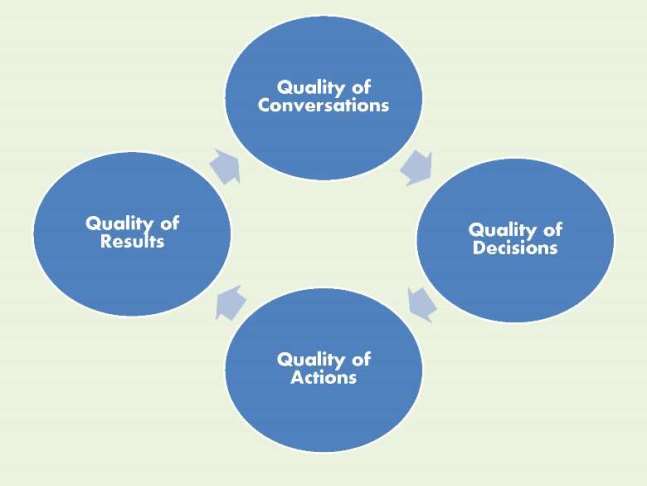
Here’s a formula.

High quality conversations lead to high quality decisions, which lead to high quality actions and ultimately, high quality results and performance. The reverse is also true. Low quality conversations eventually lead to low quality results.

Achieving high quality results and performance are worth the effort to learn how to conduct high quality conversations.

Gary RyanThe point of leverage in this model is high quality conversations. But what is a high quality conversation?

Unfortunately you have experienced more than your fair share of low quality conversations. These are ones where you walk out of the meeting and think any one of the thoughts below:

  • “Wow, that was a complete waste of time”
  • “When will people finally start to listen around here?”
  • “Why does everyone have to make my life so difficult? Why won’t they listen to me?”
  • “There’s no point saying what you really think around here because no one is going to listen anyway!”

High quality conversations are more natural than you might think. Peter Senge, author of the Fifth Discipline states,

As far as I know, no indigenous culture has yet to be found that does not have the practice of sitting in a circle and talking.

For the ancient Greeks dia logos was the ‘flow of meaning’. It was the cornerstone of civic practice. The polis was the gathering space for conversation. The purpose for the dia logos was about enabling self-government to occur. This system was the birthplace of the western world.

As time has passed the practice of dia logos has diminished. When you converse in a workplace your purpose is no longer to consider what is best for the whole. Rather, your purpose is to win. You are a master of debate. I win. You lose.

Our modern word for dia logos is dialogue. When we dialogue our purpose is not to win. It is to discover what no individual could discover on their own and it is to discover what is the best solution for the whole, not the part.

Think about the conversations that you have at work, especially the ones where everyone in the room is ‘representing‘ a specific department or unit. What is the intent that each of you bring to those conversations? Is it to do what is best for the whole organisation, or is it to defend, protect and/or promote what is best for your department or unit?

The root cause of the lack of dialogue in organisations is the lack of the practice of dialogue itself. Quite simply, well-educated and/or experienced people don’t know how to dialogue. The reverse is true. They know how to debate. It is little wonder that debate rules, but the overuse of debate lowers the overall quality of your conversations.

Debate is not bad. In fact a form of debate (known as ‘opposing’) is encouraged in the practice of dialogue. The issue with debating is that it is overused. Our conversations are out of balance. We require more use of dialogue to improve the quality of our conversations.

The solution is to learn dialogue together. The beauty of the learning process is that you can practice dialogue, while learning it, on real organisational issues.

In the foreword to William Isaacs’s book, ‘Dialogue and the art of thinking together‘, Peter Senge highlights that,

In almost every setting where practices of dialogue have become embedded and part of everyday routines, the ensuing changes have become irreversible, as near as I can tell.

The projects to which Senge was referring involved practical people such as line managers, executives and staff from mostly Fortune 500 companies. The improvements were clear. Improving the quality of work-place conversations improve performance.

The effort is worth it. Higher quality conversations lead to higher quality decisions which lead to higher quality actions and ultimately higher quality results and performance. Results and performance matter and so does improving the quality of conversations in your organisation.

What actions are you taking to improve the quality of conversations at your work-place?


Gary Ryan enables talented professionals, their teams and organisations to move Beyond Being Good®

If you would like to learn more about learning how to Dialogue, contact Gary here.

Buy1GIVE1 - Transaction Based Giving

Enabling organisations to be worthy of the commitment of employees