Tag Archives: teamwork

Why Quitting Right Now Is Dumb

You’ve had enough. You can’t handle your job anymore and you want to quit.

Don’t do it. Not if you live in Australia and you haven’t secured a new job, that’s for sure.

On Monday 23rd February the ABC Four Corners program The Jobs Game revealed the true state of unemployment in Australia. I don’t know about you, but despite all my education and experience I have always struggled to make sense of the reported unemployment figures. On the 12th of February, The Australian Bureau of Statistics (ABS) reported that Australia’s unemployment rate was 6.4 %, a rise of 0.1 percent since December 2014.

iStock_000009570322SmallWhat does an unemployment rate of 6.4% mean? In all honesty I can’t tell you and I haven’t been able to find a definition that is clear enough to share with you.

What I can tell you is that according to the ABS, 795,200 people are looking for work. The ABC Four Corners Program revealed that there are only 150,000 jobs available in Australia.

Ratios I can understand. This means that there are, on average 5.3 unemployed Australians looking for each available job. Why isn’t unemployment reported as a ratio of job seekers to jobs available?

Surely it is much easier for the average person to understand what that means, versus a figure such as 6.4%. I don’t know about you, but the figure 6.4% doesn’t represent the reality of the unemployment situation anywhere near as clearly as 5.3 people looking for each job. And that’s only an average. Clearly some jobs will have higher ratios.

Perspective matters. If more people understood the reality of the Australian unemployment situation then I believe that more people would be taking action to create more jobs, because clearly more jobs is what we need. In addition, more people will think twice about quitting their job.

If you are thinking about quitting your job, make sure that you have secured another job before you resign. Create a plan and treat your job hunting as a project. Above all else, don’t quit if you don’t have a job to go to. Not now. It just isn’t the smart thing to do.


Gary Ryan helps talented professionals like yourself, your team and organisation move Beyond Being Good.


Buy1GIVE1 - Transaction Based Giving

You Don’t Know How To Create A High Performing Team

A high performing team is one where the output or performance of the team at least equates to the output that you would expect from the collective talent of all the teams members. This statement is easy to say, but hard to achieve. In fact, 93% of my clients report that from a professional perspective they have never worked in a truly high performing team. They have worked in good teams, but not high performing ones.The Teams That Matter® model for creating high performing teams includes seven key elements. Most teams naturally do three or four of the seven elements. But it is the three or four that they aren’t doing that stops them from being a high performing team. The main reason for not doing three to four of the key elements is that they don’t know about them and they haven’t seen them modelled in the past.

1. Decide
If you intend to create a high performing team, then you must make a conscious decision to become one. Why? The three to four elements of the Teams That Matter® model that you haven’t completed in the past will require some getting used to. Your team members won’t be used to them either. Having a conversation as a team about what you would look like if you were a high performing team will help your team to clarify exactly what this statement means for them. It will then act as a catalyst for you to complete all the seven key elements of the Teams That Matter® model.

2. Purpose and Goals
Why does your team exist? The answer to this question highlights the purpose for your team. Your goals reflect the specific outcomes that you are striving to achieve. Your goals should reflect your ‘purpose in action’. Have you even been in a team where you have discussed your team’s purpose?
What if you discover that your team doesn’t have a purpose? Well, thank everybody and close the team down. Clearly time spent with this team would be a waste of time and who wants to do that in this time poor world that we live in.

3. Skills and Composition
Most teams have completed an assessment of the experience and skills of the members of their team. No doubt you have done that too.
I bet you haven’t taken steps to better understand the personality profiles of the members of your team. Or if you have, you haven’t done it in a way that has enabled you to use that information to improve communication on a daily basis among team members.
I use the What Makes People Tick tool, not because it is the most scientific, but because it is a tool that participants can use on a day to day basis beyond the introductory workshop. I find that other tools are too complex and require you to become an expert on the tool for it to be useful. Most people are too busy being experts in their own field of work to also have to become an expert on a personality profiling tool!
The benefit of understanding how each of your team members ‘tick’, is that you can modify how you communicate to ensure that your message is being delivered effectively. Effective communication is essential if you wish to become a high performing team.

4. Agreed Behaviours
Do high performing teams accept or reject unacceptable behaviour? I understand the answer to this question is a ‘no brainer!’. Yet, are you and your team members clear about what behaviours are acceptable or not for your team? Or do you assume that ‘everyone knows how to behave properly’? I’m telling you, they don’t know! Which is why you and your team need to make those behaviours explicit. Three questions is all it takes (I’ll share them in another post).

5. Plan and Measure
This is one of the elements that most team do. Although be careful with your measurements. Russell Ackoff, Professor Emeritus at the Wharton Business School said,

It’s better to do the right thing wrong, than the wrong thing right. If you do the wrong thing right you just get wronger and wronger.

Make sure that your measurements are measuring the ‘right’ things.

6. Perform
This means that you ‘do’ all seven elements in the model. It also means that you never, ever forget that if your team changes only by one person, it is a brand new team. You need to quickly review all seven elements and make any necessary adjustments. This is a critical lesson that most teams don’t know exists.

7. Monitor and Review
No doubt you monitor your progress toward your goals. Do you monitor your agreed behaviours? It’s hard to do if you haven’t made them explicit! This key element works hand in glove with the Agreed Behaviours and Plan and Measure elements.

In addition, when you complete a milestone or achieve a goal, the following four After Action Review questions are very powerful.

What did we plan?
What actually happened?
What did we learn?
What will we do next time?

Now you know how to create a high performing team. Give it a go!

Gary Ryan enables talented professionals, their teams and organisations to move Beyond Being Good.

Buy1GIVE1 - Transaction Based Giving

Innovation is not as hard as you think

Innovation. Like oxygen is necessary for survival, innovation is necessary for business. Without it you won’t last long. But what exactly is innovation? A Google search results in 409,000,000 hits. Wow, that’s a lot of different definitions and perspectives on what it is. Like ‘leadership’ (488,000,000 hits) there is so much information available about innovation that most people are confused about how to put it in to action.

Many people get stuck when it comes to taking actions to innovate because they think of it in terms of ‘inventing‘. They think that you have to invent something that is brand new, something that hasn’t been done anywhere in the world before. No doubt this form of innovation is necessary for humans to continue to progress, but it isn’t a particularly useful definition for the vast majority of us. Innovation is contextual.

The ‘never been done before‘ context is best considered within your local context. If your team has never conducted ‘stand up meetings‘ before and you introduce them and they become an effective form of communication for your team, then you have innovated. If you introduce an app that helps your team to more quickly access sales data while they are out on the road, and the use of that app is useful for your team, then you have innovated. If you copy and modify the telephone welcome script from a company that you visited yourself as a customer, and the new script ‘works‘ for your team and improved engagement with your customers, then you have innovated. If you visit another department in your organisation and you copy their approach to how they understand the expectations of their customers to your department and it improves your customer relationships, then you have innovated.Innovation is more ‘doable‘ than you think.

If you take something (a process, a service, a product) and put it with something else (an idea, a concept, a new process, another service, another product) and what they produce when they are put together is useful, then you have innovated.

In terms of the recruitment process interviewers are more regularly asking interviewees to share how they have contributed to innovation. Seeing innovation from the perspective that I have shared with you will enable you to have clear responses to those questions. And that has to help your chances of getting the job you want!

Take out your tablet and note down the innovations that you have helped bring to your organisation. If you can’t find any, then remember the simple formula. If you take something and place it with something else and what they create together is useful, then you have innovated.

Gary Ryan enables talented professionals, their teams and organisations to move Beyond Being Good.

Buy1GIVE1 - Transaction Based Giving

A Better Way To Manage Your Task List

Most effective people who I know use a task list to help them to stay focused throughout the day. Some randomly work their way through their list, while others start at the top and work their way down.

Gary RyanA better way to manage your task list and to improve your daily effectiveness is to follow these simple steps.

1. Prepare your list

This is a classic brainstorm of all the tasks that you need to complete today. Given it is a brainstorm your list will be in a random order in terms of priority.

2. Identify your high value tasks

Rate each task in the context of value that you receive from completing the task. A ‘High’ rating means that the completed task gives you a lot of value in the context of what your role requires you to do, a ‘Medium’ rating gives you medium value and a ‘Low’ rating gives you low value.

3. Identify your hard-to-do tasks

Rate each task for how hard you find it to complete the task. A ‘High’ rating means that you find this task difficult to do (such as having that ‘important’ conversation with your colleague about her ability to meet deadlines). A ‘Medium’ rating is a task that is moderately difficult for you to do and a ‘Low’ rating is a task that you find relatively easy to do.

4. Identify how long it takes you to complete each task

Rate each task in terms of how long it will take you to complete the task. a ‘High’ rating means that the task will take you a long time to complete (you decide your time scale for yourself as it will depend on the type of work that you do), a ‘Medium’ rating means that it will take a reasonable amount of time, and a ‘Low’ rating means that you can complete the task quickly.

5. Complete your tasks in the following order

A. High Value, Hard To Do Tasks That Can Be Done Quickly (H/H/L Task Rating)

In his book Eat That Frog, Brian Tracy refers to these tasks as your frog. If you were to eat a frog at the start of each day, nothing you do for the rest of the day will be as bad as eating that frog! In this context, your High Leverage, Hard-To-Do Tasks that can be done relatively quickly are your ‘frogs’. When you do these tasks first, you clear your mind for the rest of the day. This is a terrific habit to form. When you know that at some stage during the day you are going to have to eat a frog, it clouds your mind until you do it. So you might as well get it over and done with at the start of the day! You won’t regret it!

B. High Value, Easy To Do Tasks That Can Be Done Quickly (H/L/L Task Rating)

Getting these tasks completed creates a sense of accomplishment and shortens your to-do list in the process!

C. High Value, Easy To Do Tasks That Have a Medium and/or High Time Rating

These tasks take longer for your to complete them, but they provide high value in the context of your role.

D. High Value, Hard To Do Tasks That Take a Long Time To Complete (H/H/H Task Rating)

In my world these are my proposals. Each one needs to be tailored to my clients specific needs, so they tend to take a fair amount of time to create. I require decent chunks of dedicated time to complete this task. Knowing that I have already completed other high value tasks before getting to these provides me with the clear ‘mental space‘ that I need to get on with completing this task.

E. Everything else on your list

All these tasks are the things that provide a level of value but aren’t the most important tasks that you need to get done. Sometimes you may find that these tasks can change in value if they are time related. As a deadline nears the value in completing the task may rise. If you find yourself moving these tasks across to your new task list each day (because they aren’t being completed), make sure that you continue to rate them just in case their value has changed. Another option is to set aside an hour or two every week that is dedicated to completing these tasks.

If you follow the five steps that I have outlined above you will discover that you get more high value work done than you do today. Give it a try and let me know how you go!

Gary Ryan enables talented professionals, their teams and organisations to move Beyond Being Good.

Project Matrix For Learning

My first permanent job was to commercialise a fitness centre for Monash University in the early 1990s. I was the only permanent employee and had a strong team of casual employees with whom I worked. I quickly learned that there was too much that needed to be done in a short period and that I needed to better use the full suite of talents of the members in the team.

Projects For LearningI was aware of the various interests and strengths of the team members that went beyond their skills and ability as Gym Instructors. One team member was studying Information Technology and had a clear passion for it, another was highly officious and had a passion for consistency among the team, and yet another loved to organise things.

I knew that somehow that I had to find a way to tap into their talents that would benefit the Fitness Centre and themselves, and not break my budget!

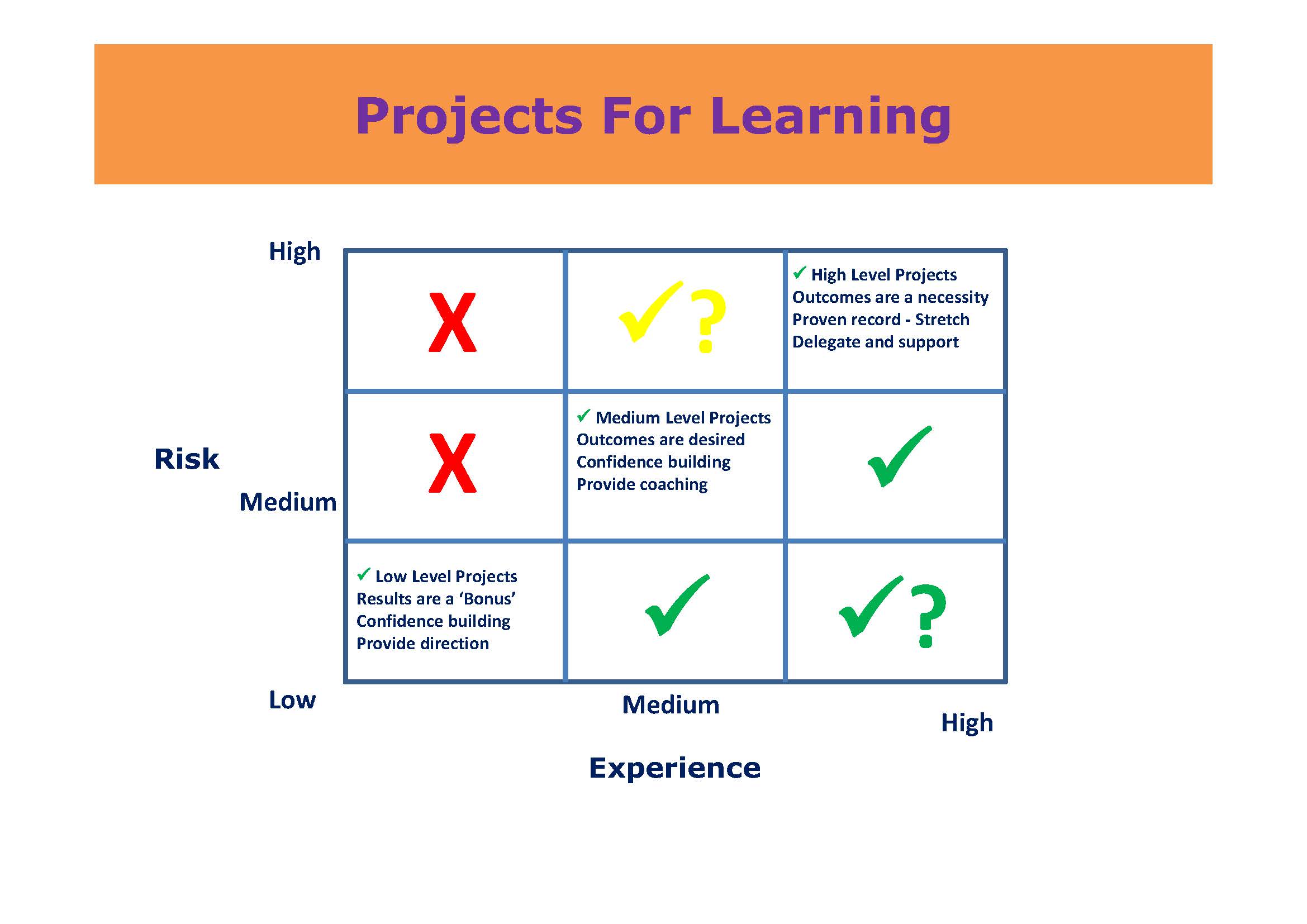
I drew up a list of the tasks that needed to be completed. I then rated each of those tasks from a Risk perspective. A Low rating meant that the outcome was a ‘nice to have‘. If it got completed it was a ‘Bonus‘. A Medium rating meant that the outcome was important and the performance of the Fitness Centre would be reduced or slowed if it wasn’t completed in a timely manner. A High rating meant that the task was extremely important to the performance of the Fitness Centre and if it wasn’t completed properly the Fitness Centre would suffer serious consequences which meant that I wouldn’t have been doing my job properly.

Before you ask, the option to hire more permanent staff was not available. First I had to generate the revenue that would eventually pay for more full-time staff. It was a great challenge!

I spoke with each team member and asked if they were interested in leading a project to help us create the performance we desired. All team members said ‘Yes‘. I arranged their schedules so that they had time during their normal shifts to work on their projects. I knew that this meant that they wouldn’t be ‘on the floor‘ as much as normal but I was prepared to take a half step backward to take five steps forward. We also agreed that the projects would have a six-week timeframe within which they needed to be completed.

I took responsibility for all the High rated projects. It was my head that was on the ‘chopping block‘ if we failed so it was only fair that I took responsibility for those projects. I ‘parked‘ the Medium rated projects. I decided to wait until after the first round of projects had been completed and then use that experience to assign the medium rated projects. I needed to have confidence that the medium rated projects would be done properly. I also knew that I would have to coach the team members through those projects which meant that I would need to have more time available to provide that assistance.

I could not have been happier with the results of the first round of projects. The team member who had a passion for I.T. completed an important project that related to setting up ‘norms‘ as comparative data for our fitness tests. The ‘officious’ team member completed a project that set clear standards for the fitness testing procedures and protocols that the team was using. The ‘organised’ team member completed a project that involved re-organising the equipment to improve the ‘flow’ in and around the equipment. I managed to complete the High rated projects as well.

This experience taught me at a very young age the power of projects for learning. Projects create real outcomes. By assigning low risk projects to my team members I was able to tap into their passion and skill. If they ‘failed‘ I wasn’t going to ‘lose‘ anything. By tapping into their passions I also increased the likelihood that their first projects would be a success – which they were! That success built confidence and provided energy for the Medium rated projects which were also embraced and successfully completed by the team with great enthusiasm.

Best of all our success drove the performance results that we were seeking which meant that the following year I was able to engage a number of the team in permanent roles.

I also learnt a great lesson. A lesson that I continue to use to this day. Projects are a powerful tool for creating results, building confidence and assessing team member capabilities. They allow you to learn a great deal about your team members. They also allow your team members to learn that they can produce results themselves.

I created the Projects For Learning Matrix above and have used it many times throughout my career. I assign Low risk projects to inexperienced team members, Medium risk projects to team members who have ‘proven’ themselves and High risk projects to highly experienced, energetic and motivated team members. I avoid giving too many low risk projects to highly experienced and motivated team members – it is better to use those projects to developed inexperienced people.

I have found this simple matrix to be useful and highly effective over many years. I am confident that you will too!

Gary Ryan enables talented professionals, their teams and organisations to move Beyond Being Good.

Walk Tall

On a good day I am 170 centimetres tall (five foot seven). It’s fair to say that I’m not a tall man.

Confused, young businessman looking at chalk drawn arrows on a cGrowing up in suburban Melbourne, Australia I dreamed of being an Australian Rules footballer. Unfortunately I forgot to get in the queue for skills and talent when I was being made! So I didn’t have much natural talent when it came to sport. That said I loved sport and coupled with being a determined little fellow I made the best of what I did have and played and coached Australian Rules football until I was 30 years old.

Dreams, however, have a funny way of coming true. As a result of my professional career in November 2006 I was invited by Ray Mclean, a founding director of Leading Teams Australia to be interviewed by Kane Johnson, then the captain of the Richmond Tigers and some of his fellow Leadership Team members about taking on the role of mentoring Kane and facilitating a program for the leadership group at Richmond.

Despite having many years of public speaking and leadership facilitation behind me I remember feeling extremely nervous as I drove to Swan Street in Richmond for our meeting that day. Who was I, this guy who was a ‘battler’ at best to tell these elite athletes about leadership? What had I gotten myself in to! I kept thinking to myself.

My negative self-talk was making me more and more nervous. You know the feeling. I started to feel sick in the stomach. Maybe I should cancel the meeting, after all I clearly don’t feel well. My mind was racing.

But then the skills that I had developed over time, which was one of the reasons why I had been asked to take on this job, kicked in.

I can do this. I am good enough. I do know a lot about leadership. Just be yourself. If they don’t like you, that’s okay. Not everybody has to like you. Just be yourself, listen to them and be honest in your answers.

As I got out of my car I was still nervous but I felt more in control of the situation and more in control of my mind.

Walking toward the cafe where we were to meet I kept saying to myself, Walk tall Gazza, walk tall!

No doubt that may seem strange coming from a man only 170 centimetres tall. But it summed up all of my positive self-talk. I felt a sense of calm in terms of preparing to meet these champions of the game. Ray Mclean had confidence in me so why shouldn’t I! If it turns out that I’m not the right person for the job, then that’s okay. It doesn’t make me less of a human being.

Needless to say the meeting went well and I ended up mentoring Kane and working with the Richmond Leadership group, the coaches and the playing list. In fact, I sat in the coach’s box in the 2007 Round 1 game versus Carlton and had the opportunity to stand in the middle of ground before the game, at the quarter-time and at three-quarter time. There was a crowd of nearly 80,000 in the Melbourne Cricket Ground and here I was standing in the middle of it. While I wasn’t a player, I was there as a professional! In fact, I was being paid to be there.

I teach people that it is important to let your dreams come true via a thousand pathways. Life is too complex to limit yourself to a single route toward success. Constructive self-talk, as demonstrated by my story is critical along this journey. I don’t believe that it is possible to 100% eliminate negative self-talk. I do believe that when negative self-talk occurs then you have the power and control to change it to something more constructive so you can take whatever action you need to create the success you desire. This may be relevant when you are going for a job interview, a promotion, delivering a presentation, speaking with senior executives or starting an exercise program. Learning to master your self-talk is a strategy that enhances success and will enable you to bring your dreams into reality.

Gary Ryan enables leaders and their teams to move Beyond Being Good™.

Failure and Success

One of the biggest challenges associated with creating life balance and personal success relates to how you manage failure.

Yes For Success, Life balance, plan for personal success, Gary Ryan, Organisations That MatterFailure can manifest in many ways:

  • You don’t get offered the job after you attend an interview
  • The project you are working on doesn’t achieve budget
  • You lose three kilograms instead of four kilograms
  • You have a ‘rest’ day when you were supposed to go for a five kilometre jog
  • You yell at your child when they climb the fence
  • You only read three literature articles when you had intended to read five

Creating success invariably includes many small failures. None of us are perfect so you will let yourself down from time to time. However, if you focus too much on when you have let yourself down and failed, you risk letting the negative energy from failure grow even more and cause more failure.

Equally we can’t disregard failure and pretend that it doesn’t matter. Clearly it does matter when we fail because it delays us from achieving the success we desire.

What then, can we do about failure?

In simple terms you can learn from it. Not a unique concept I know. Your learning will be on multiple levels. For example, what did you learn about your expectations? Were they realistic? On this point it is my experience that one of the only ways to discover what is realistic is to create an expectation, ideally a high one, and then go and do everything you can to achieve it. In doing so you may then have a ‘reality check’ in which a lot of valuable learning can occur.

What did you learn about your planning? Was the planning process itself ‘solid’? Did it help you to consider unintended consequences?

What did you learn about how you put your plan into action? Did you follow your plan or did you just make up each step of your journey as you went along in complete disregard of your plan?

When you did whatever you did, how could it have been done better? This last question can also lead to too much focus on failure if it isn’t done correctly. In retrospect it is always very easy to say that you should have known better. No doubt sometimes you should. There will be other times when your plan was the best that it could have been at the time. How you executed your plan could have also been better. Retrospect highlights the gap between what we did and what we could have done based on what we have just learned. In other words it will be rare for you to take action and then decide that there wasn’t anything that you could have done to have done it better. Retrospect, by nature highlights learning gaps.

Despite your failures, when traveling the journey of creating more success and life balance it is important to notice your progress. Become acutely aware of your small successes and despite all your failures, focus on learning from them to help you continue your journey toward more and more success.

Find out more about the Yes For Success Program here.

Gary Ryan enables leaders and their teams to move Beyond Being Good™.

Harvard Research Aligns With Life Balance and Personal Success Program

Harvard University researchers Boris Groysberg and Robin Abrahams have recently released the findings of their research that involved almost 4,000 executives worldwide. Their article Manage Your Work, Manage Your Life (Harvard Business Review March 2014 p.p. 58-66) identifies key factors that are addressed by the Yes For Success 10 Module Program (keep in mind that the Yes For Success program has evolved since March 2007). Here are some of their key findings with the corresponding Yes For Success Module(s) that address that finding:

  1. Yes For Success Program For Life Balance and Personal SuccessDefine Success For YourselfThis is what the Yes For Success Program is about and specifically it is in Module 5 you get to put your definition down on paper
  2. Managing Technology – One of the Bonus programs inside the Yes For Success Platform is the 21 Module Yes For Career Success program where several modules are dedicated to helping you better use technology in the context of managing your time and achieving high performance
  3. Building Support NetworksModule 2 of the Yes For Success program includes a section on identifying your Personal Success Team, which is 100% about creating a support network
  4. Traveling or Relocating Selectively Module 5 includes a section that helps you to find the role that travel will play in your life, including the possibility of having multiple ‘homes’
  5. Collaborating With Your PartnerModules 2 and 5 address this issue, as does the specific actions that you identify in Module 8. If you don’t have a current partner, but want one, Yes For Success can help with that issue too (we have had weddings happen as a result of people executing their plans – including actions to find love!)
  6. There Are Multiple Routes To Successonce again all 10 Modules re-enforce this concept, while enabling you to follow a simple step by step process to identify your own answer and route to success. In addition, while everyone’s route to success is unique, it doesn’t mean that you can’t learn from the success of other people – Yes For Success is a community where members share their strategies that are enabling them to create success
  7. Life happensModule 9 includes a section on what to do when ‘life happens’ and things get in the way of you executing your plan

My own experience of facilitating the Yes For Success Program is that it works. The seven key points identified in the Harvard research are all addressed through the program. Find out more about the Yes For Success Program here.

Gary Ryan enables leaders and their teams to move Beyond Being Good™.

Jason Barrie’s Perspective On Health & Fitness

On May 1st 1999 Jason Barrie’s life changed forever. Playing local Australian Rules Football he was involved in a tragic accident, the result of which left him as an Incomplete Quadriplegic. Jason often describes himself as, “The luckiest, unlucky man alive“. Despite being an Incomplete Quadriplegic, Jason is able to walk. While his spinal cord was damaged in his accident, it wasn’t completely severed. This means that he has about 80% use of the right side of his body, but considerably less on the left side of his body.

The Yes For Success Platform is an online service that steps members through a process for identifying and creating a plan for life balance and personal success. Every month members have access to a Question and Answer Webinar where they can ask questions that relate to their personal success. The above video is a recording of the February 2014 member-only webinar. Usually these videos are kept for the exclusive use of members of the Yes For Success Platform.

However Jason’s story where he shares his perspective on health and fitness is so inspiring I just had to share it. Enjoy it and please feel free to share it with others.

Gary Ryan enables leaders and their teams to move Beyond Being Good™.

Chaos and order ARE the natural order of things

Dee Hock, Founder and CEO Emeritus of VISA International, arguably the most profitable organisation in the world, explains in his book One From Many, that chaos and order are the natural order of things.

Consider this. VISA exists to exchange value, represented by digital money. How can chaos be part of such a world? Surely everything must be ordered for VISA to function.

senior couple of old man and woman sitting on the beach watchingYet its founder argues that while it is human to desire everything to be in order, the natural order of life is that it isn’t.

To demonstrate please come for a walk with me. You are standing on the edge of the ocean facing inland. Slowly you walk up the beach. At first you encounter some small sand-dunes with no sand grass on them. Then you notice some larger sand-dunes with scattered sand grass. The sand grass gets thicker as you venture inland from the waterline. Gradually the sand grass begins to give way to small shrubs, then bigger shrubs. You start to notice less sand and more dirt under your feet. Soon you are entering a forest with tall trees and shelter from the sun and the beach seems a long way behind you.

This walk seems orderly. There is an obvious progression and change from sand to sand grass, to small shrubs and eventually to fully grown trees. Yet there is a large degree of chaos that exists within the order presented above.

Sand-dunes shift. Which seed of sand grass survives and which one doesn’t is seemingly random. The same issue exists for the seeds for the small shrubs and finally the larger trees. Chaos exists side by side with order.

Dee Hock created the word ‘Chaordic‘ to describe this reality.

People who do not understand that chaos and order co-exist are constantly frustrated. As much as we may try to make the world orderly, it isn’t. One of the primary reasons is that humans are chaordic by nature. We have the power of choice and will exercise that choice in both rational and irrational ways.

Leaders need to understand that ‘chaos happens‘ from time to time. A highly valued staff member resigns and tells you they are leaving the industry. The government changes a law which directly impacts your revenue. Your computer system crashes due to a virus.

I’m not advocating that you shouldn’t do whatever you can to increase order. Look at traffic on our roads as an example. What would happen to the road toll if we eliminated speed limits and traffic lights? It is hard to imagine that increasing chaos on our roads wouldn’t increase accidents and therefore deaths. Clearly more orderly roads are safer for us all. But accidents still happen and some humans choose to break the rules.

My point is that no matter how hard we try to control everything, chaos will find a way to penetrate our order. Why? Because, it is the natural order of things.

As a leader, your challenge is to develop the capacity to live with and manage chaos when it comes. Because it will come.

Gary Ryan enables leaders and their teams to move Beyond Being Good™.

Enabling organisations to be worthy of the commitment of employees